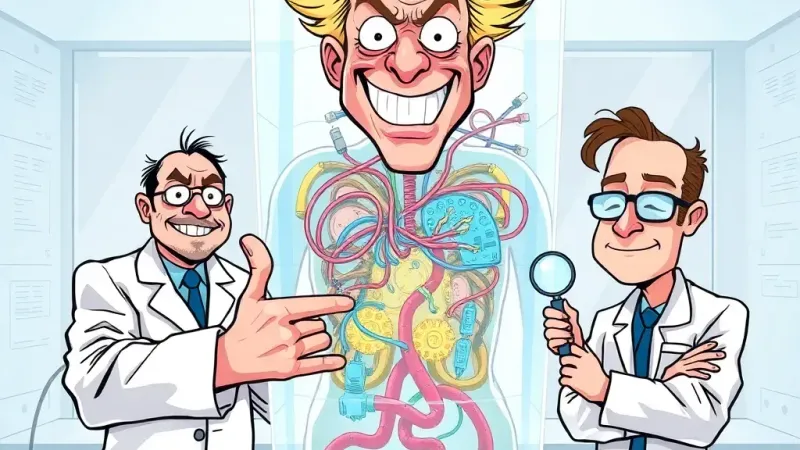
CHICAGO, IL – In a stunning revelation that promises to reshape humanity's understanding of itself, researchers at the University of Chicago’s Pritzker School of Molecular Engineering announced today a breakthrough 2 capable of demonstrating that the human body functions as a single, interconnected system, rather than a collection of independent, specialized meat-sacks. The discovery, facilitated by a novel 'Pan-Organ Recombinant Interface Mapping' (PORIM) array, is being hailed as the most significant leap forward since the realization that limbs are typically attached.
For decades, medical 2 has operated under the assumption that the liver, kidneys, and brain largely minded their own business, interacting only when absolutely unavoidable. "We've always known, anecdotally, that if you stub your toe, your face tends to make a noise," stated Dr. Lena Harding, lead researcher and head of the newly formed Department of Holistically Integrated Biological Connectivity (DHBC). "But now, with precise cellular data across 37 distinct biological markers, we can definitively prove that a persistent hangnail in the left pinky finger can, in fact, negatively impact the spirit of the entire organism, leading to measurable dips in a person's willingness to help move a couch by approximately 8.7% according to our preliminary findings."
The implications for specialized medicine are profound. Cardiologists, neurologists, and gastroenterologists, who previously focused almost exclusively on their respective domains, are reportedly forming inter-departmental book clubs and considering cross-disciplinary potlucks. Medical schools, traditionally structured around compartmentalized organ systems, are now scrambling to integrate 'Whole Human Connectivity 101' into next year's curriculum, potentially requiring students to hold hands and feel each other's vibes.
"Frankly, it's a lot to take in," admitted Dr. Marcus Thorne, a veteran pulmonologist who now faces the prospect of understanding how his patient's chronic cough might be influenced by, say, their lingering resentment over a forgotten birthday card. "My entire career was built on the premise that lungs don't care about emotional baggage or interpersonal slights. This changes everything, and by 'everything,' I mean my retirement plans for a remote cabin, possibly in an off-grid location to minimize systemic stress."
The team is now working on a follow-up study to determine if the human body is also connected to the outside world, or if that’s just a theory.