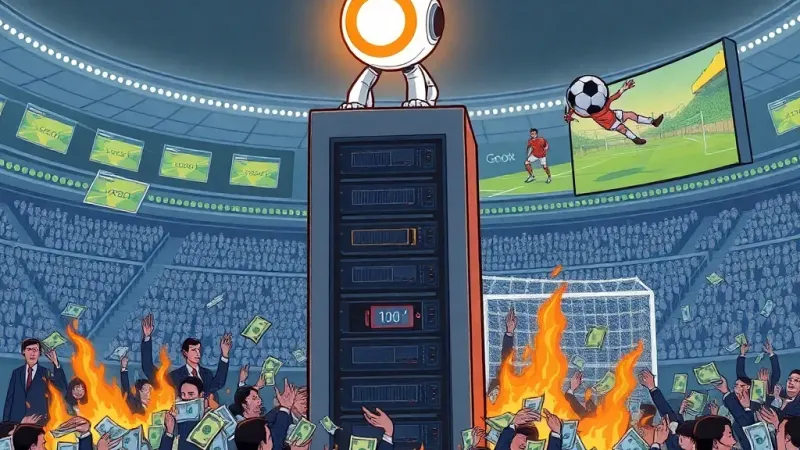
2 — Billions in advanced computational power, trillions of data points, and unparalleled access to the world’s information have culminated in a sobering conclusion: 2, especially xAI’s Grok, is demonstrably worse at predicting Premier League soccer outcomes than a coin flip, according to a new multi-institutional study. The report, published Tuesday, detailed how various large language models consistently misfired on match results, prop bets, and even basic goal differentials, leading to widespread financial hemorrhaging among venture capitalists and crypto bros who apparently thought AI had cracked the code on human 2.
The study revealed Grok, xAI’s flagship model, achieved a negative ROI of 187% over a single season, frequently selecting underdog teams with no historical momentum or overestimating the strategic brilliance of managers notorious for last-minute tactical blunders. "It's almost as if Grok understands the statistics of 2, but completely misses the '2' part of football," explained Dr. Elara Vance, Professor of Algorithmic Disappointment at the University of Southern California, and lead author of the report. "It’ll pick a team based on optimal possession metrics, then be blindsided when a goalkeeper slips on a rogue banana peel during injury time. It just can't grasp the chaotic poetry of a 0-0 draw decided by a questionable offside call in the 93rd minute. Or the sheer will to win of a player whose wife just left him.”
Other AI models from Google, OpenAI, and Anthropic fared only marginally better, collectively failing to outperform a syndicate of elderly retired postal workers in Stoke-on-Trent who base their bets solely on uniform color. The findings have prompted a crisis of confidence in the tech sector, with some investors reportedly now employing reverse-Grok strategies, betting exclusively against the AI's predictions, a method that has shown promising early returns. One frustrated investor, who lost a reported $75 million betting on Grok’s 'sure things,' was quoted as saying, "I just wanted an edge. Instead, I got an algorithm that genuinely thinks Sheffield United are going to win the Champions League next year, 'based on projected growth trajectories and optimal player-to-pitch ratio.'"
xAI's Senior Solutions Architect, Brandt Dingle, issued a statement assuring stakeholders that Grok’s performance was not a 'failure,' but rather an 'unconventional exploration into non-linear outcome probabilities.' He added, "Our models are pushing the boundaries of what constitutes 'wrong' in predictive analytics. We view these 'losses' as valuable data points in understanding the nuanced irrationality of the human spirit, especially when confronted with a ball and 22 highly paid athletes." Critics, however, suggest that the nuanced irrationality Grok is truly understanding might just be its own.
Hambry is a satire publication. All articles are works of fiction.