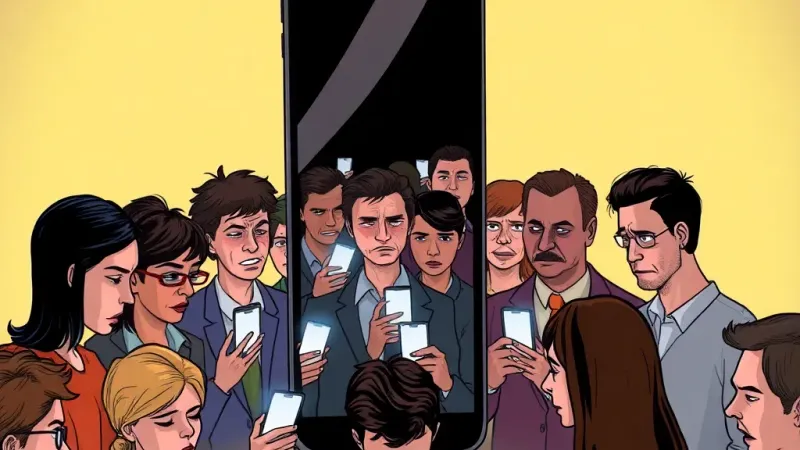
CAMBRIDGE, MA – In a revelation expected to shake absolutely no one, a new book by Harvard-trained neuroscientist Dr. Jared Cooney Horvath has "discovered" that prolonged engagement with digital devices can lead to widespread feelings of mild discontent, eye strain, and the pervasive sense that one is probably missing out on something less virtual. His seminal work, *The Digital Delusion: Why Your Brain Hates Apps and What To Do About It*, meticulously compiles years of anecdotal evidence previously known as "Monday morning conversations," "that nagging feeling in your gut," and "every single comment section online."
Dr. Horvath’s extensive research, funded partially by a grant from the "Foundation for the Utterly Self-Evident," involved observing test subjects as they scrolled through social media feeds for what he termed "an alarming number of hours — approximately 4.7 hours on average for adults aged 18-54." Participants were then asked to rate their emotional state on a scale from "Blissful" to "Why did I just do that?" The overwhelming majority reported responses ranging from "not good enough to justify this time sink" to "I feel like a slightly damp sponge," confirming a hypothesis first posited by early 20th-century philosopher O.V. Blatant. "What we're seeing here is a profound, albeit entirely predictable, neurological feedback loop where sustained passive consumption directly correlates with a decrease in self-reported genuine joy," explained Dr. Evelyn Precedent, a leading expert in the Department of Common Sense at the University of Daily Experience. "Essentially, when humans spend their entire waking lives staring at glowing rectangles, their brains process this information as 'not ideal for long-term psychological flourishing, despite the algorithmic push for dopamine hits.'"
The book posits that symptoms of this so-called "digital delusion" include an inability to recall the previous five minutes of content consumed, a heightened sensitivity to phantom phone vibrations, and the occasional urge to throw one's device into a large body of water or, at the very least, into a drawer for 20 minutes. Early reviews from prestigious academic journals have hailed the findings as "a bold articulation of something everyone has been silently screaming about for a decade" and "a welcome addition to the growing body of literature confirming gravity exists, even in digital spaces." Critics noted that the book's 300 pages could have been condensed into a single sticky note that reads: "Go outside, dummy." Publishers are reportedly bracing for a sales surge from individuals who desperately need a physical object, ironically, to validate their amorphous sense of tech-induced dread.
"It's a profoundly complex issue, truly, understanding why people might feel vaguely unfulfilled after endlessly consuming optimized content designed specifically for addiction and continuous engagement," said Reginald 'Reggie' Byte, spokesperson for the Institute for Obvious Conclusions. "Our preliminary models suggest a robust correlation between spending more time staring at a glowing rectangle and spending less time engaging in activities that don't involve a glowing rectangle, which, surprisingly, are often more fulfilling, like talking to another human or looking at a tree. More rigorous, multi-year research is certainly needed, of course, preferably funded by grants from the very tech companies whose products seem to be causing this universally acknowledged malaise. We anticipate another book on this topic in approximately two to three years."
Experts now predict a surge in "digital detox" retreats where participants pay thousands of dollars to be told what they could have figured out by leaving their phone at home for an afternoon, or simply reading the book and then immediately forgetting its advice.