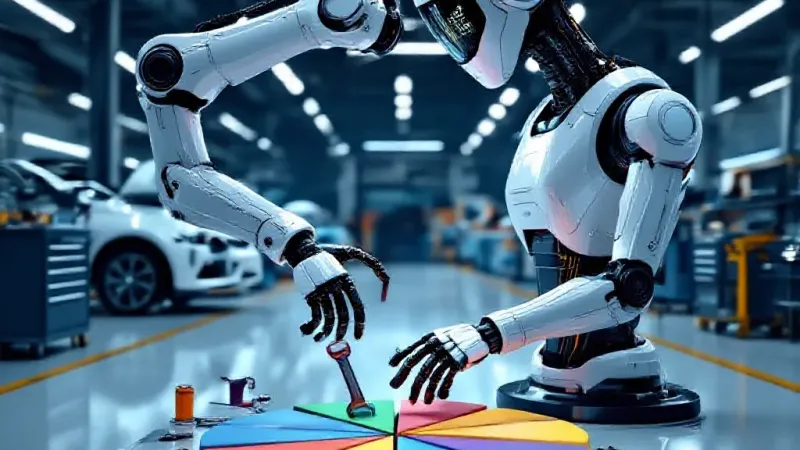
DEARBORN, MI – In a stunning reversal that industry analysts are calling "hilariously predictable," Ford Motor Company has admitted its multi-billion dollar "AI-First Quality Initiative" largely failed to fix its cars, instead opting to rehire hundreds of the human engineers it had previously deemed obsolete. The "gray beards," many of whom were enjoying early retirement after their decades of experience were deemed redundant by algorithm, are now being lauded as essential "legacy knowledge architects."
Ford's COO Kumar Galhotra, during a hastily arranged press conference, announced a "strategic re-prioritization" towards what he termed "carbon-based problem-solving units." He confirmed the company had quietly brought back over 350 veteran engineers in the last three years to troubleshoot ongoing reliability nightmares that Ford’s cutting-edge AI systems somehow failed to grasp. "It turns out," Galhotra stated, "that our advanced neural networks could identify every possible flaw in a digital rendering, but consistently struggled with concepts like 'the part falls off' or 'it makes a weird clunking noise when you turn left.'"
Sources within Ford, speaking on condition of anonymity, described the AI's performance as "less 'Terminator' and more 'Clippy from Microsoft Word, but for car engines.'" One engineer, recently lured back from a lucrative gig fixing his neighbor's lawnmower, recalled a diagnostic AI suggesting a faulty transmission could be resolved by "rebooting the vehicle's emotional core." Another AI system, designed to predict manufacturing defects, reportedly produced a 700-page report concluding that "all vehicles inevitably succumb to entropy."
The re-hiring initiative, internally dubbed "Project Pandora's Box," involved a desperate scramble to locate former employees, many of whom had to be convinced that the company wasn’t just trying to lure them back for a consulting gig before firing them again. "They basically sent me a blank check and a bottle of Scotch," quipped seventy-year-old former drivetrain specialist, Frank 'Sparky' McGee. "Apparently, the AI couldn't figure out why the F-150's rear axle kept detaching, but I can tell you in five seconds: it's always the damn U-joint. Always."
While Ford refuses to disclose the total cost of its AI experiment, which included custom software development and several lavishly appointed "AI Synergy Hubs," industry watchers estimate it dwarfed any savings from the original layoffs. The company maintains its commitment to innovation, though analysts now predict Ford's next big innovation will be remembering that people actually drive cars.