
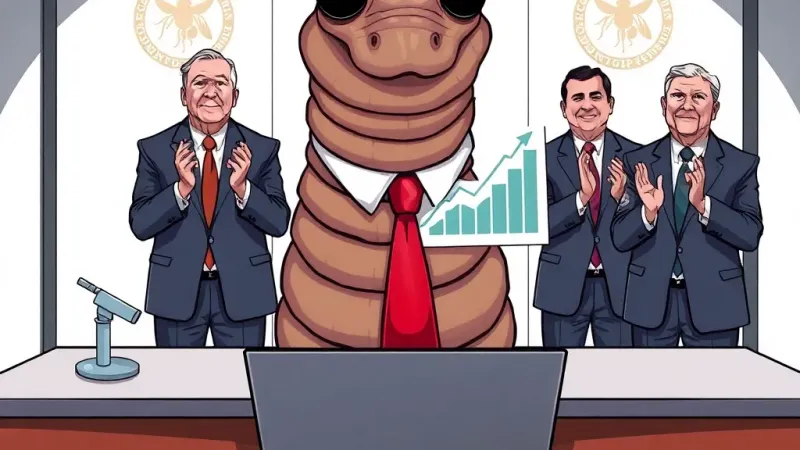
WASHINGTON D.C. — In a move designed to "optimize national bio-asset management," a newly formed federal task force has announced its intention to explore the economic potential of the impending New World screwworm fly invasion, rather than focus solely on its eradication. The interagency body, comprising officials from the USDA, CDC, and the freshly minted Office of Biological Resource Monetization (OBRM), stated that initial projections suggest "significant untapped market value" in the organism.
"While some may view the Cochliomyia hominivorax as a mere pest, we see a complex biological entity ripe for strategic integration," stated Dr. Aris Thorne, OBRM’s Chief Innovation Officer, at a press briefing. "Our preliminary analysis indicates robust opportunities in fields ranging from specialized wound care solutions to bio-containment infrastructure development. We're looking at a multi-billion dollar ecosystem here, if managed correctly. The traditional 'eradicate and forget' model is, frankly, unsustainable and overlooks valuable national assets."
The task force outlined a multi-phase plan, beginning with the establishment of "Controlled Bio-Diversity Zones" (CBDZs) in designated regions, where researchers and accredited private sector partners can study the fly's behavioral patterns and potential applications. Critics, largely confined to obscure academic journals and rural veterinarian associations, voiced concerns over the ethical implications and public health risks. However, Dr. Thorne reassured the public that the CBDZs would be "rigorously monitored for optimal yield and minimal public interaction," suggesting that citizens could be eligible for "participation incentives" if their properties fall within these newly designated areas.
Funding for these initiatives is expected to come from a new "Biological Resource Impact Fee" levied on healthcare providers and a proposed "Fly Futures Market" allowing investors to trade derivatives based on regional infestation levels. "We’re not just passively accepting this," added Director Dana Finch of the USDA's Office of Agricultural Resilience, "we’re proactively shaping the narrative. We aim to reposition the screwworm from 'parasite' to 'bio-economic catalyst.' It's about perception, really."
Private equity firms and biotechnology startups have already begun lobbying efforts, presenting proposals for everything from proprietary maggot-therapy derivatives to advanced fly-larva harvesting technologies. Analysts predict a surge in related venture capital funding, with early estimates suggesting the "Screwworm 2" could contribute up to 0.15% to the national GDP within five years, provided a steady supply of hosts. The flies themselves, however, remain oblivious to their newfound corporate designation.