
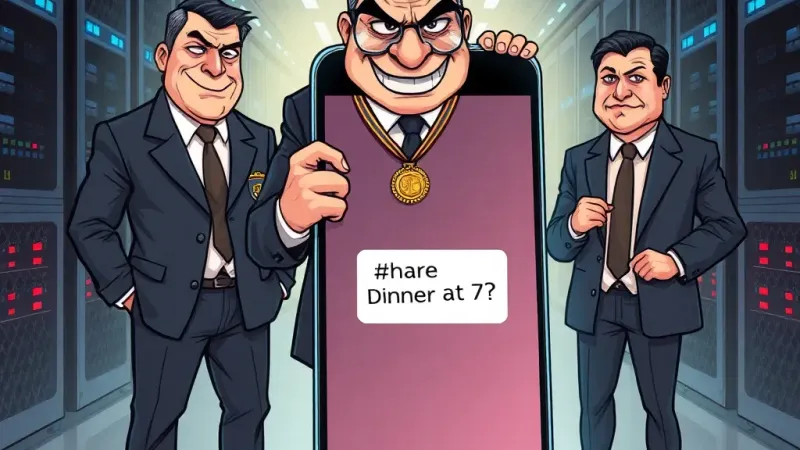
WASHINGTON D.C. — In a significant advancement for national security, the Federal Bureau of Investigation announced today a novel method allowing agents to effectively monitor supposedly "end-to-end encrypted" communications: by reviewing the push notifications displayed directly on device lock screens. Dubbed "Operation Screen Peek," the technique has already proven instrumental in several high-profile convictions, including individuals involved in domestic extremism plots.
TheThe bureau hailed the breakthrough as a testament to its relentless pursuit of justice, effectively rendering the most robust encryption protocols moot. "For years, we've faced a 'dark privacy' challenge, where criminals could hide behind layers of complex algorithms," stated Special Agent Harrison Finch, head of the FBI's Digital Surveillance Innovation Unit. "But our team realized that while the content might be scrambled in transit, the summary often appears unencrypted on the device itself. It's a game-changer, really. Like trying to build a soundproof vault, but leaving a tiny window open for friendly birds to drop off little summaries of what's inside."
Privacy advocates, while acknowledging the operational success, expressed bewilderment at the FBI's characterization of the method. Dr. Evelyn Reed, a cybersecurity ethics professor at the University of West Central Arizona, noted, "Push notifications are a fundamental feature of modern smartphones. They're designed for user convenience, to give you a quick glance at incoming information without unlocking your phone. To call observing them an 'innovative technique' for bypassing encryption is like calling looking through a window 'an innovative technique' for bypassing a locked door." Reed added that most major platforms offer options to disable or limit notification previews, a feature she assumed sophisticated actors would utilize.
Despite the obvious nature of the 'workaround,' law enforcement officials maintained that the ingenuity lay in formalizing its application and securing judicial approval for accessing the notification metadata from device manufacturers. "It's about procedure, precision, and leveraging every available pixel of information," Agent Finch elaborated. "We're not just 'reading over someone's shoulder'; we're doing it at scale, with warrants, and with the full understanding that a well-placed notification can tell us everything we need to know before the target even has a chance to fully encrypt their thoughts."
Tech companies, who have long marketed their apps on the promise of impenetrable privacy, are reportedly re-evaluating their marketing strategies. One anonymous executive from a prominent messaging service commented, "We guarantee end-to-end encryption. That's true for the data *in transit*. We never said anything about the data making a pit stop on a glowing public billboard on your device."
Ultimately, the FBI's success with "Operation Screen Peek" suggests a future where digital security isn't just about protecting the message, but also about managing how desperately your phone wants to show it to you.
Sources close to the investigation confirmed the next phase involves agents simply standing near suspects and listening.