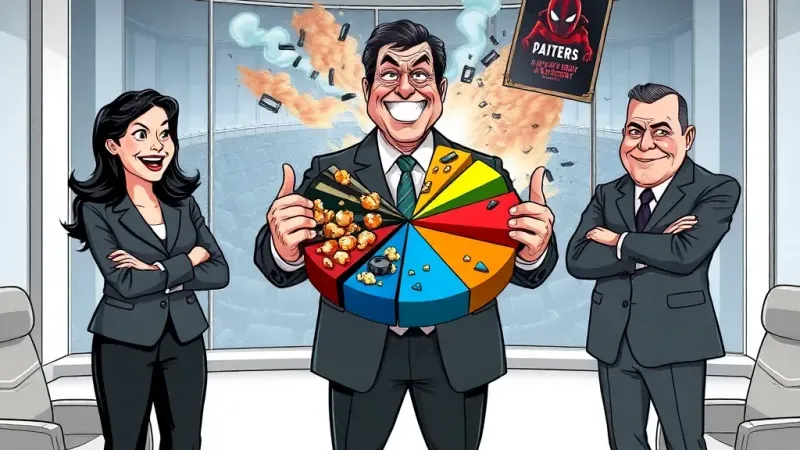
2, CA – In a bold move that has left industry analysts both bewildered and begrudgingly impressed, studio executives at Global Pictures defended the catastrophic box office performance of their 2 tentpole release, *28 Years Later: The Bone Temple*, by declaring its historic failure a “groundbreaking triumph in advanced audience segmentation.” The highly anticipated sequel, which garnered a paltry $3.2 million worldwide against a $180 million budget, is now being hailed internally as a crucial data-gathering exercise.
“While traditional metrics might suggest a lack of public interest, our proprietary analytical framework, 'Audience Resonance Through Aversion (ARTA),' clearly indicates *The Bone Temple* was an unparalleled success in identifying specific non-target demographics,” stated Global Pictures CEO Reginald Sterling in an internal memo obtained by Hambry. “We have definitively isolated a segment of the global population, previously thought to be interested in cinematic storytelling, that exhibits zero engagement with our product. This is invaluable.”
Sterling elaborated that the film's abysmal performance revealed a previously undetected demographic of moviegoers who actively chose *not* to see a sequel to a beloved horror franchise featuring an apocalyptic landscape and a titular 'Bone Temple.' He posited that understanding this inverse preference would allow the studio to more efficiently allocate marketing resources away from these specific individuals in the future. “Why spend billions trying to convert the unconverted? We’ve identified them. Now we can ignore them with surgical precision,” Sterling concluded, reportedly to a standing ovation from his executive team.
Industry consultant Dr. Felicity Quinn of the Quinn-Data Group, a firm specializing in post-failure narrative restructuring, confirmed the legitimacy of Global Pictures’ new approach. “Historically, a flop meant you made a bad movie. But in the era of AI-driven content strategy, a flop is merely a high-fidelity data point,” Quinn explained. “*The Bone Temple* didn't just fail; it failed *specifically*. It didn’t appeal to people who like scary movies, or people who like action, or even people who just like movies. That's a powerful dataset. It tells us exactly who to not market to next time we release a film exactly like this one.”
Sources close to the production noted that the studio is already leveraging this insight, announcing plans for *28.1 Years Later: The Bone Sanctuary*, a prequel set to target the newly identified segment of consumers who were “not actively repelled” by the original’s marketing. Global Pictures anticipates a similarly precise lack of engagement to fine-tune future investment strategies.
“Our goal isn't just to make movies; it’s to monetize the information gleaned from every creative endeavor, successful or otherwise,” Sterling’s memo concluded. “If a film doesn’t make money, it must make data. And *The Bone Temple* just generated a goldmine of negative preference metrics.”
The studio has reportedly already begun pre-production on several new projects designed to target specific subsections of the population that demonstrably prefer not to attend cinematic features, including a historical drama about wallpaper and a silent film about watching paint dry, both featuring prominent 'Bone Temple' Easter eggs.