
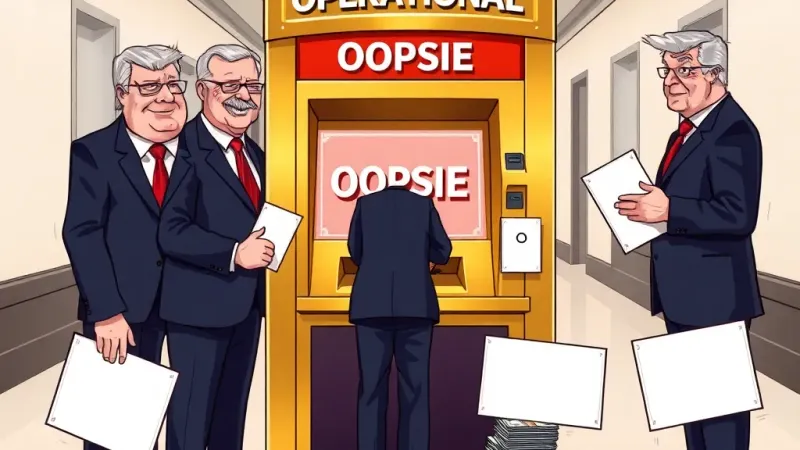
WASHINGTON D.C. – The Department of Justice (DOJ) today announced the formal creation of its "Operational Oopsie" budget category, effective immediately, following a recent seven-figure settlement to Mark Houck. The new budgetary allocation, projected to be a recurring line item, aims to streamline the financial impact of what officials termed "unforeseen administrative enthusiasm" and "strategic outreach miscalculations" by federal agencies.
The initiative will allocate substantial funds for significant legal settlements stemming from federal actions later deemed procedurally flawed, constitutionally questionable, or simply "excessively enthusiastic." A leaked internal DOJ memo, obtained exclusively by Hambry, outlined the parameters for what qualifies as an "Oopsie," ranging from "Category A: Administrative Zeal Overdrive" to "Category D: Preemptive Litigation Avoidance." Specific examples include "instances where the application of federal power outpaces judicial review," "enthusiastic interpretations of jurisdictional mandates," and "general instances of being caught red-handed by the appellate courts." Officials stressed this is not an admission of guilt, but rather a "proactive fiscal strategy."
"Look, we're a large, dynamic organization with a broad mandate, and sometimes, in the pursuit of justice—or what we perceive as justice at the time—we might occasionally overstep the line, or perhaps even a whole block," admitted Assistant Attorney General for Administrative Fiscal Oversight, Brenda Halpert, in a surprisingly candid press briefing. "Rather than surprise taxpayers with ad-hoc, reactive payouts that necessitate emergency budget adjustments, we're simply building in a predictable, annualized cost. Think of it as preventative maintenance for public trust – it's more efficient to have a dedicated fund for these 'learning experiences' than to keep rummaging behind the couch for millions every time we get an unfavorable ruling. This fund ensures continuity of operations, even when those operations occasionally result in us paying someone millions of dollars." She added that the fund will also cover costs associated with "future historical corrections" and "proactive apology initiatives designed for maximum positive press."
The new budgetary category was reportedly fast-tracked following the substantial seven-figure settlement awarded to Mark Houck, a pro-life activist whose 2022 arrest by armed federal agents at his home was widely criticized as disproportionate and politically motivated. While specifics of that particular settlement remain confidential, sources within the DOJ suggest it served as a "proof of concept" for the urgent need for a standardized "Operational Oopsie" fund. A representative from the National Alliance of Taxpayer Protection, Dr. Evelyn Reed, expressed a mix of weary resignation and cautious optimism. "On the one hand, it's horrifying to institutionalize government screw-ups as a permanent budget item," Reed stated. "On the other, at least now there's a line item we can point to. It's like a transparent admission that they're just going to keep doing it, but now we're funding it proactively. We're essentially pre-paying for our own potential future harassment."
Experts predict the "Operational Oopsie" budget will likely become the fastest-growing segment of federal spending, second only to "consulting fees for explaining why other budgets are shrinking."