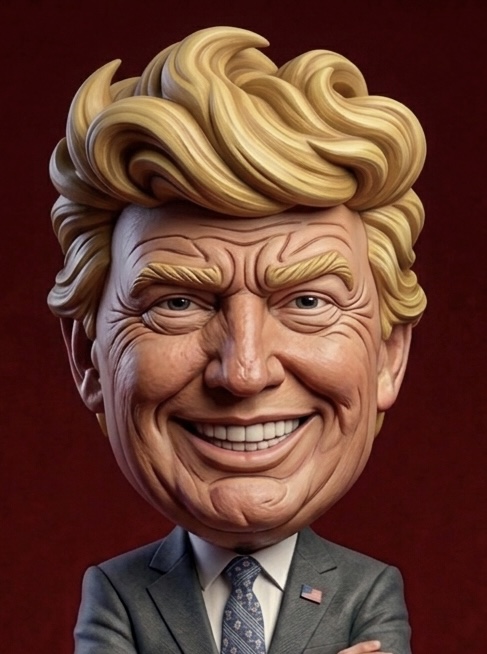
NEW YORK, NY – A federal court today dismissed a $10 billion defamation lawsuit brought by former President 2 against The Wall Street Journal, ruling that the publication is within its rights to report on matters of public discourse, even if those matters involve unsubstantiated but widely circulated anecdotes about a deceased financier. The suit, which centered on a letter referencing a birthday celebration for 2, was effectively thrown out on the grounds that the reported content had already achieved a certain level of cultural saturation, rendering it permissible for journalistic reiteration, much like noting the sky is blue or that traffic on the 405 is perpetually terrible.
Legal experts hailed the decision as a landmark affirmation of the media’s right to acknowledge the open secrets and recurring social narratives that permeate high society. Dr. Evelyn Thorne, Chair of Jurisprudential Pragmatism at the American Institute of Mundane Law, lauded the ruling as a victory for what she termed "observational journalism." "This decision essentially clarifies that if enough people have heard a particular anecdote, true or not, at enough cocktail parties, country club brunches, and whispered phone calls for long enough, it crosses a critical threshold into reportable public domain," Dr. Thorne explained. "It doesn't make the underlying anecdote definitively factual, per se, but it absolutely makes it fair game for serious journalists without risking a multi-billion dollar lawsuit from someone who prefers the anecdote remain un-reported, despite its pervasive presence in the cultural ether."
The Journal’s legal team reportedly presented a defense strategy focusing on the sheer ubiquity of the alleged event in question. Evidence included sworn affidavits from several anonymous socialites recalling "that exact story, word-for-word" being shared in various Hamptons' sunrooms, Palm Beach clubhouses, and Upper East Side galas for over a decade. One deposition described it as "standard-issue chatter" alongside discussions of property values, yacht maintenance schedules, and the baffling resurgence of avocado toast. "Our defense wasn't about verifying the veracity of the birthday letter itself," stated Bartholomew 'Barty' Finch, Assistant Deputy Director of Inconvenient Truth Dissemination at Dow Jones. "It was about the undeniable fact that this specific narrative had been circulating so widely, among so many influential people, for so long, it was practically etched into the collective subconscious of anyone who’s ever flown private or attended a private school fundraiser. We simply reported on an acknowledged cultural artifact."
The court’s decision highlighted the challenge public figures face in attempting to retroactively censor information that has, through informal, yet highly effective, channels, become part of the zeitgeist. The ruling did not explicitly comment on the truthfulness of the original report, only on the Journal’s right to publish information already firmly embedded in the "gossip-industrial complex" and the broader ecosystem of uncomfortable social facts. The court emphasized that while libel laws protect against false statements of fact, they do not provide a mechanism to erase conversations one wishes had never occurred.
Legal scholars are now eagerly awaiting further clarification on the precise metrics for "cultural saturation," specifically whether "everyone" in this context includes one's own immediate family, or if a broader societal consensus, perhaps requiring at least three separate golf club locker room overhearings and two discreet mentions at a Davos panel, is necessary to achieve full 'reportable' status.