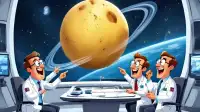
BEIJING — The People’s Republic of China today unveiled its meticulously detailed new lunar map, complete with a groundbreaking homegrown cartographic standard that observers say will streamline future disputes over celestial real estate. The map, hailed by state media as a "triumph of scientific precision," features never-before-seen data of the moon’s far side, along with conveniently precise boundaries delineating what the People's Liberation Army (PLA) Space Force has already earmarked for mineral extraction and future "recreational orbital vehicle parking."
"This new standard isn't about abstract science; it's about clarity and foresight," explained Dr. Wen Li, Director of the Chinese Academy of Lunar Territorial Administration (CALTA), during a press briefing where he gestured vaguely at a projected image of the moon, which now bore an uncanny resemblance to a freshly subdivided suburban development plan. "By standardizing our nomenclature — replacing outdated, colonialist names with ones reflecting true lunar heritage and national interest — we eliminate any ambiguity. For instance, what Western powers call 'Mare Tranquillitatis' is now officially 'Productive Helium-3 Extraction Zone 1: Friendship & Prosperity'."
The map also introduces several new "Special Economic Zones" around key impact craters and lava tubes, which CALTA assures the international community will be open to "collaborative partnerships" under strictly Chinese-defined terms, naturally. Satellite imagery embedded in the map also appears to include faint, almost imperceptible outlines of what analysts believe are future PLA bases, conveniently positioned to "protect shared lunar resources" from, presumably, anyone not operating under the new Chinese cartographic standard.
Western space agencies, currently navigating their own underfunded lunar missions, issued mild statements of "concern" regarding the unilateral nature of the new map. One anonymous source at NASA reportedly mumbled something about "not being able to afford a new atlas every time Beijing updates its claims." Meanwhile, Elon Musk tweeted a single, unpunctuated query: "How many Starships 2 secure Moon?"
Ultimately, the new map is expected to serve as the definitive guide for all future lunar activity, at least according to Beijing. Any discrepancies with existing maps, officials noted, are merely "errors of historical perspective" that will be corrected with the inevitable arrival of a Chinese lunar customs office.