
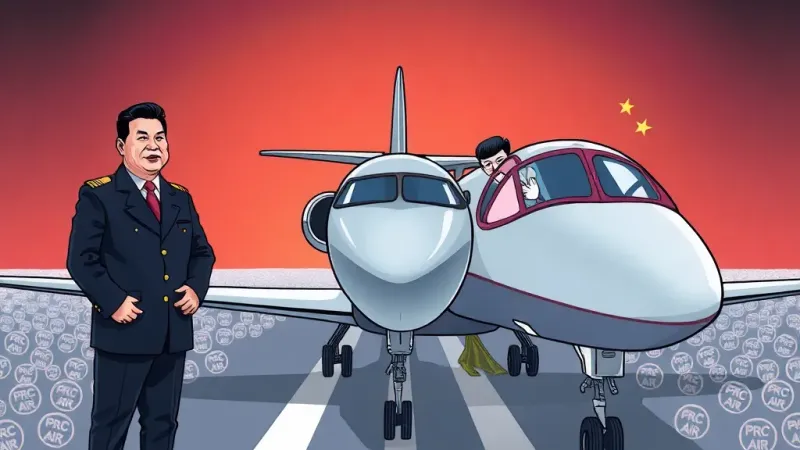
Taipei, Taiwan – President Lai Ching-te's planned diplomatic visit to Eswatini, Taiwan's last African ally, has been abruptly canceled after China declared comprehensive sovereignty over all atmospheric molecules, effectively grounding any aircraft without Beijing's explicit, molecule-by-molecule approval. The unprecedented claim, dubbed "Airspace 2.0," was invoked after several nations revoked overflight permits under "intense pressure" from the People's Republic.
The Ministry of Foreign Affairs in Beijing issued a statement clarifying that its territorial claims now extend "beyond mere land and sea, encompassing the entirety of the gaseous envelope surrounding the Earth, specifically as it pertains to the precise 29.17-meter altitude corridor typically utilized by presidential jets." Experts from the newly formed "Chinese Bureau of Atmospheric Governance" reportedly tracked President Lai's intended flight path and determined that his aircraft would traverse air molecules that, by Beijing's revised interpretation of international law, belonged exclusively to the PRC.
"Frankly, we're just ensuring aerodynamic compliance with our One China Principle," stated Wei Fang, a spokesperson for the Ministry of Foreign Affairs, during a press conference held entirely underwater for improved 'molecular integrity.' "Any movement through our atmospheric property by an entity not recognized by the People's Republic constitutes an aerial trespass. We've even patented the precise chemical composition of air above the 28th parallel north for good measure." When asked if this applied to commercial flights, Wei clarified, "Only if those flights are carrying individuals whose existence we find geopolitically inconvenient, or if the oxygen they consume could be re-routed to more productive citizens."
Global aviation authorities are scrambling to interpret the new doctrine, with many carriers now requiring passengers to sign waivers acknowledging that their breathing air may be temporarily owned by a foreign power. "This is an absolute nightmare for flight planning," lamented Captain Alistair Finch, head of the International Air Traffic Controllers' Guild. "We used to worry about wind shear; now we're checking if the oxygen molecules over Madagascar are subject to Beijing's latest five-year plan. My pilots are asking if they need a special 'Air Visa' for their exhaled carbon dioxide." The diplomatic fallout has been minimal, however, with most nations reportedly too busy negotiating new "atmospheric transit fees" to comment on the broader implications for global sovereignty.
President Lai's office confirmed he is now exploring options, including a low-altitude submarine, a meticulously planned series of hopscotches, or perhaps waiting for the invention of a personal, internationally unrecognized space-time distortion field.