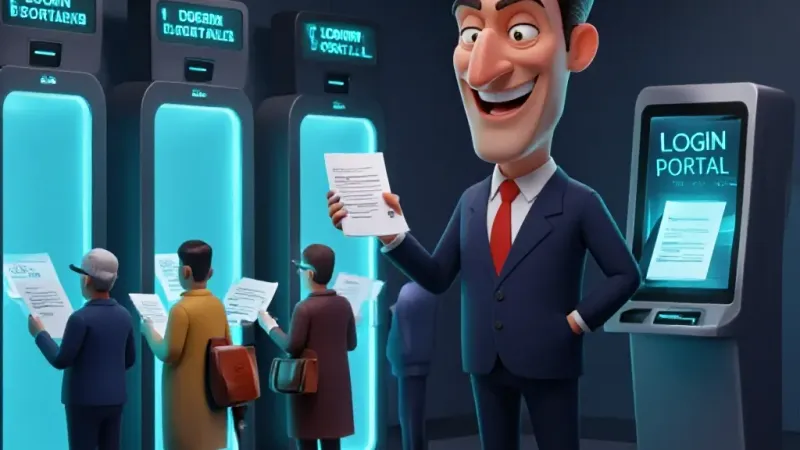
Taipei, Taiwan – The National Science and Technology Council (NSTC) today announced a record-breaking technology budget for 2027, earmarking billions to transition essential government services from tangible, easily legible paper documents to complex, multi-platform digital forms. The council asserts this groundbreaking shift will usher in an era of unprecedented user frustration and data migration errors, all while ensuring no actual improvement in service delivery.
"This isn't just about moving pixels; it's about re-imagining inefficiency with a contemporary interface," stated Dr. Mei Lin, lead digital transformation architect for the NSTC. "Imagine waiting in a virtual queue for three hours, only to be told your meticulously uploaded, AI-encrypted digital signature still requires a wet ink stamp from a physical location that only accepts cash. That's the kind of cutting-edge synergy we're targeting." Dr. Lin enthusiastically added that preliminary "impact studies" conducted via an outsourced consultancy confirmed a significant uptick in citizens purchasing new printers and ink cartridges, solely to print out the "digitized" forms for physical submission because the online portal repeatedly crashed. This surge in personal hardware investment, she noted, was a clear indicator of "successful citizen engagement."
The new budget specifically allocates $500 million for "AI-enhanced authentication protocols" that will randomly lock users out of their accounts for their own protection, requiring a series of security questions nobody remembers, followed by a mandatory 72-hour lockout for "system recalibration." Another $300 million is earmarked for "cloud-based data sovereignty solutions" which translates directly to storing sensitive citizen data on various unregulated offshore servers, ensuring maximal geopolitical complexity and minimum accountability. Furthermore, a substantial portion will fund a "User Experience Optimization Task Force" whose sole mission is to craft error messages so vague and unhelpful they generate more support calls than actual solutions, thereby demonstrating the "need" for increased tech support staffing next fiscal year.
Citizens interviewed across multiple age demographics expressed a potent mix of weary resignation and anticipatory dread. "I just finally figured out how to use the QR code for parking," lamented local resident Mr. Chen, 78, while attempting to refresh a government website on his flip phone. "Now they want me to apply for a new ID using a blockchain-verified virtual reality avatar in a metaverse platform that requires a monthly subscription? I just hope my children, or more likely their children, can figure out how to pay my taxes when I inevitably lose my password, which will probably happen tomorrow." Another citizen, Ms. Lee, 34, noted her family still uses a fax machine for most important documents and wasn't sure what "the cloud" even was, beyond something that occasionally blocked the sun.
When pressed on the actual benefits of digitizing perfectly functional paper systems, an NSTC spokesperson simply noted that the new digital forms would definitely generate more data points for future, even larger, technology budgets, thereby ensuring ongoing "digital innovation" and continued employment for the council.