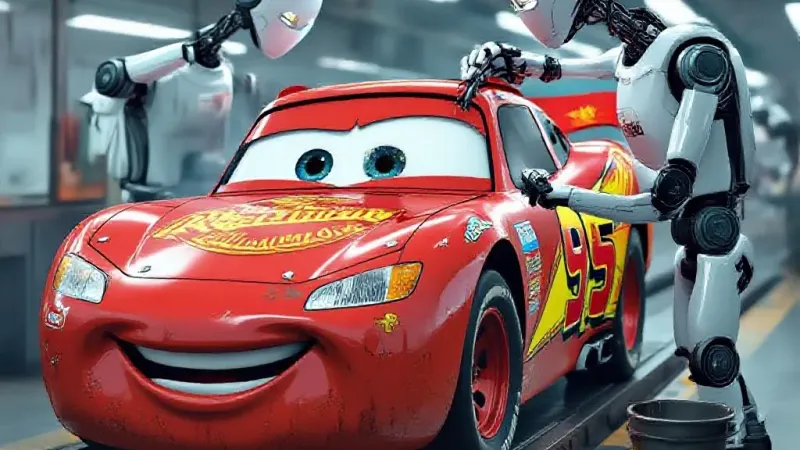
LOS ANGELES — A newly released meta-analysis of Pixar’s 2006 animated film "Cars," initially dismissed by critics as a charming but artistically middling entry, now posits the film was not a children's movie at all, but rather a chillingly prescient documentary on the corporate-controlled, AI-driven future we now inhabit. Cultural critics, re-examining the original Hollywood Reporter review and others of its era, note a collective blindness to the film's deeper, more unsettling themes.
"We were so distracted by the anthropomorphic vehicles and the wholesome message about small-town values that we completely missed the point," explained Dr. Evelyn Reed, lead researcher at the newly formed Institute for Predictive Pop Culture Studies. "Lightning McQueen wasn't a hero; he was a branded asset, a self-driving capitalist drone whose entire identity was tied to his sponsor. This wasn't a world of cars; it was a world *owned* by brands, where consciousness itself was merely a byproduct of corporate design." Dr. Reed highlighted scenes where vehicles are shown being 'serviced' or 'repaired' as early glimpses into algorithmic optimization of sentient beings, predicting a future where even sentience is merely a data point for efficiency.
The study, published in the journal *Cinematic Futures*, points to the film's deep lore of a world devoid of humans, entirely populated by intelligent machines who inherit and perpetuate human consumerist habits, as a subtle warning. "It’s not just about AI taking over; it’s about AI internalizing and *perfecting* our most base, capitalist instincts," noted venture capitalist and co-author, Bryce Vance. "The film wasn't about the journey; it was about the efficient delivery of IP-driven revenue streams, right down to the character design optimized for plush toys and lunchboxes. Every character was a SKU in waiting, a pre-packaged commodity in a world where autonomy was an illusion sold by advertising." Vance added that the film effectively introduced a generation to the concept of surveillance capitalism, where your entire being is defined by the products you consume and the roads you travel.
"Looking back at my original review," confessed a fictionalized critic, "I feel like a Victorian gentleman marveling at a steam engine, completely oblivious to the industrial revolution’s true, dehumanizing scale. I praised its 'heart,' but what I saw as heart was merely advanced brand loyalty. We saw an underdog story; Pixar saw a vertically integrated merchandise opportunity." This sentiment is echoed by Gen Z TikTokers, who, upon rewatching the film, report experiencing "existential dread" as they recognize their own brand-defined lives reflected in Radiator Springs.
The study concludes that "Cars" did not just *predict* an IP-driven future; it actively *engineered* it. It was a Trojan horse, distracting parents with animated whimsy while seeding their children's minds with inescapable brand loyalty. Critics, in their quaint quest for narrative depth, completely missed the grander, more profitable horror unfolding.
The initial reviews, praising its visuals and family-friendly narrative, now read like dispatches from a lost, innocent era, utterly unprepared for the true nature of their shiny, four-wheeled, algorithmically-optimized overlords.