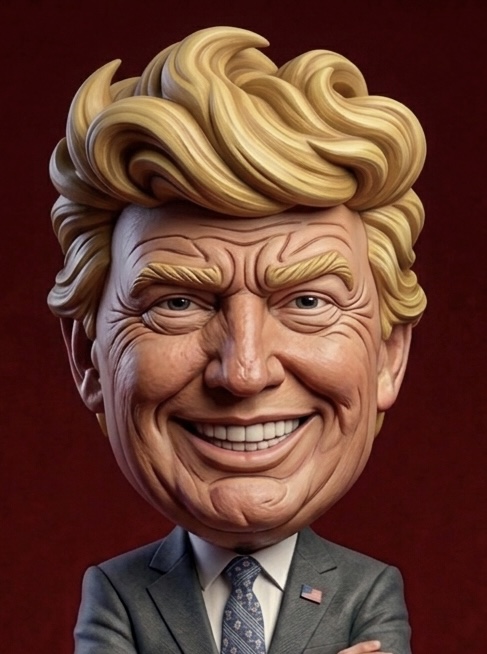
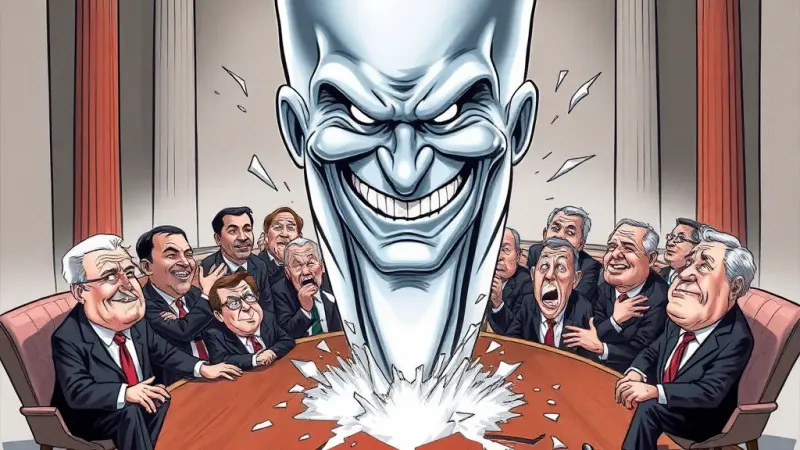
SACRAMENTO — The California Republican Party (CAGOP) has reportedly entered a period of profound self-reflection and urgent strategizing after recent internal polling and a specially convened "Cohesion & Coherence Task Force" revealed that its most prominent national figure, former President Donald J. Trump, is, in fact, quite divisive. The discovery has thrown the party's upcoming election endorsement process into unprecedented disarray.
Party officials, who had reportedly operated under the assumption that public perception of Mr. Trump had somehow unified over the past decade, were reportedly "visibly shaken" by data confirming that voters hold strongly divergent opinions of him. "We've always known the former President inspires passion," stated Brenda Harding, a long-time CAGOP committeewoman and head of the newly formed "Navigating Unified Disunity" subcommittee. "But to see it quantified, in black and white, that 'divisive' means 'causing division' – well, it really hit us like a sack of hammers made of pure, unadulterated reality."
The Task Force's preliminary report, obtained exclusively by Hambry, indicated a 98% correlation between "support for Trump" and "strong disapproval from non-supporters," a finding described by lead researcher Dr. Miles Corinth, Professor of Obvious Sociology at the University of 2, as "statistically profound in its utter predictability." Dr. Corinth noted, "It appears that when a political figure builds a career on stark contrasts and direct challenges to established norms, those contrasts and challenges tend to, you know, create factions. Our models show a clear, almost mathematical relationship between 'being widely seen as divisive' and 'generating division'."
Sources within the CAGOP central committee suggest that the shock has led to multiple emergency sessions, including one particularly heated meeting where a proposal to simply ask candidates if they support "winning elections" was tabled due to concerns it might alienate voters who prefer "ideological purity over electoral success." Another faction suggested adopting a "hear no evil, see no evil, tweet no evil" approach to national party dynamics, a strategy quickly dismissed when it was pointed out that the internet exists. The party is now considering forming an "Endorsement Unity Council" whose sole purpose will be to find a candidate endorsement strategy that manages to upset exactly zero people, a goal described by analysts as "the political equivalent of finding a unicorn that also cures cancer and bakes artisanal sourdough."
The challenge now facing California Republicans is whether they can find a path forward that acknowledges the former president's undeniable influence without alienating the substantial portion of the electorate that finds his influence, well, undeniable in a negative way. The party's state chairman, Robert "Rob" Henderson, summarized the conundrum in a leaked memo: "It seems our biggest asset is also... our biggest asset. But like, in a bad way. A really, really bad way for some people. And those people vote."
The groundbreaking discovery has reportedly left many within the party wondering if this "divisiveness" phenomenon might also be affecting other state Republican parties nationwide.