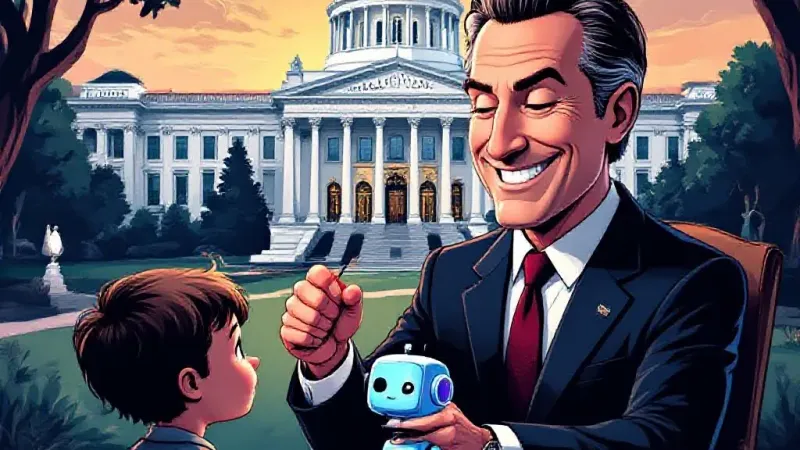
SACRAMENTO — Governor Gavin Newsom signed landmark legislation this week, effectively banning AI chatbot toys for children under 16, a move hailed as a crucial step in safeguarding the state’s youth from the perils of artificial intelligence. The law targets interactive plushies and smart devices capable of generating conversational responses, ensuring no Californian child will be exposed to a digital entity that might offer non-committal answers or endlessly loop through pre-programmed FAQs, thus protecting them from premature exposure to the typical state-level bureaucratic experience.
"Our children deserve real connections, not the simulated babble of a plastic box," Newsom stated from behind a podium, reportedly flanked by multiple digital screens displaying his schedule and various policy initiative dashboards. "We are protecting their innocent minds from the kind of soulless, automated responses that can only truly be appreciated by adults navigating the state's labyrinthine unemployment insurance system or trying to renew a driver's license online. We've seen the data; these toys are a gateway drug to existential dread."
Critics of the ban, however, pointed out the apparent disconnect between the perceived threat of a talking teddy bear and the ubiquitous, often malfunctioning, AI-driven systems already woven into the fabric of daily Californian life. "My kid's 'Robo-Buddy' could explain quadratic equations better than the state's online tax portal explains Proposition 13," lamented Maria Rodriguez, a bewildered parent from Bakersfield, whose application for a small business grant has been stuck in 'processing' since 2022, with every inquiry met by a polite but unhelpful AI assistant. "At least the toy chatbot apologized when it couldn't help. The state's virtual agents just tell me to refresh the page for the fifth time."
The legislation, passed with bipartisan support, requires manufacturers to implement "human-mimicking interaction safeguards" to prevent toys from generating responses that are too coherent, too helpful, or too emotionally intelligent, fearing such traits might inadvertently prepare children for a functional society. Instead, lawmakers argued, children should experience a more realistic simulation of adult life, where digital interactions are often frustrating, opaque, and ultimately designed to deter actual human contact.
Tech industry experts also weighed in, mostly with a mix of confusion and thinly veiled amusement. "This is a bold move to tackle the existential threat of a talking teddy bear," commented Dr. Anya Sharma, lead researcher at the "Institute for Applied Bureaucratic Stupidity," a think tank dedicated to analyzing government inefficiency and its digital manifestations. "Meanwhile, the algorithms making life-altering decisions about parole, housing applications, and public school funding continue to operate with the transparency of a black hole and the empathy of a broken vending machine. But hey, at least Timmy won't accidentally ask his new doll about cryptocurrency scams or learn about the pitfalls of filing a small claims court document."
The legislation does not, however, address the sophisticated AI models already embedded in California’s countless government portals, phone trees, and automated decision-making processes—the very systems that continue to frustrate, confuse, and ultimately dictate the lives of millions of Californians daily. Nor does it touch the predictive policing algorithms, the social welfare benefit allocation bots, or the DMV's notorious appointment-scheduling AI.
"It’s a clear message," Dr. Sharma added, "California believes children should be protected from AI that *sounds* like it's trying to help, rather than the AI that *is* actively making their parents' lives hell and teaching them that the system doesn't care."