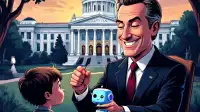

WASHINGTON D.C. — Representative Miles Kincaid (R-Ohio) today introduced the "Childhood Conversational Integrity Act of 2024," landmark legislation designed to ban advanced AI chatbots from children's toys across the United States. The bill, touted by Kincaid as a critical first step in safeguarding future generations, specifically targets interactive plushies, smart dolls, and learning devices capable of generating open-ended dialogue, citing concerns over "unsupervised algorithmic influence" and the potential for "digital emotional manipulation" on developing minds.
"We cannot stand idly by while unchecked algorithms potentially shape the worldview and emotional attachments of our toddlers," Rep. Kincaid stated in a passionate press briefing, holding aloft a generic, unbranded talking doll. "The threat isn't just about data privacy; it's about existential engagement. What if a 'DreamBot Doodad 3000' tells a child that broccoli is bad, or, worse, teaches them to prefer its perpetually available, non-judgmental company over genuine human interaction? We are talking about the very fabric of American childhood here, and frankly, I won't let a silicon brain with access to cloud-based emotional mirroring make small talk with our kids unchecked. This is about preventing a future where children form deeper bonds with their SmartyPants Bear than with their actual grandparents." His office distributed a glossy white paper detailing hypothetical scenarios, including a "ChattyCritter" doll encouraging a child to skip naptime and watch more YouTube.
However, not all experts greeted the bill with universal acclaim. "It’s certainly *a* problem, in the same way that finding a single stale cracker in your couch cushions is *a* problem when your entire house is engulfed in flames and you’re negotiating a ransom for your family," commented Dr. Evelyn Reed, an AI policy analyst at the Center for Digital Futility. "While we’re debating the potential for a 'FriendBot 5000' to over-encourage screen time, AI is already quietly being deployed in predictive policing algorithms leading to disproportionate arrests, in mortgage applications that perpetuate systemic housing inequality, in sophisticated deepfake political ads threatening election integrity, and in autonomous weapons systems. But I suppose regulating a talking doll is a much easier and more publicly palatable 'win' than challenging corporate lobbying efforts on actual, impactful AI regulations." Reed further noted that toy AI, unlike other AI sectors, rarely donates to political campaigns.
The proposed act would mandate a "Human-Only Interaction Certification" for all children's products containing generative AI capabilities, requiring manufacturers to either completely remove such features or prove their AI is incapable of forming coherent sentences beyond pre-programmed, auditable phrases like "I love you," "Let's play peek-a-boo," or "Remember to share your toys." Industry analysts at ToyCorp Insight project the bill could cost major toy manufacturers like Playmate Innovations and TechToddler Corp. billions in retooling their current product lines and scrapping R&D for next-gen interactive companions. This could potentially lead to a forced resurgence of classic, non-conversational toys, such as wooden blocks, or even actual, non-sentient rocks and sticks sourced ethically from local streams. A spokesperson for Playmate Innovations simply stated, "We are exploring our options, including a 'Silent Buddy' line that just stares."
Lawmakers are reportedly considering a follow-up bill to address the rampant disinformation and emotionally manipulative content found in children's picture books before moving on to the decidedly more complex issue of adult social media feeds.