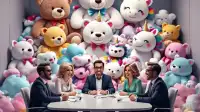
Build-A-Bear Workshop today issued an urgent recall of over 170,000 plush toys in the U.S., prompting the beloved custom-toy retailer to release extensive guidance for parents on how to help their children emotionally disengage from the potentially hazardous stuffed animals. The recall, affecting specific batches of "Sparkle Paws Unicorns" (SKU #7473-A) and "Heroic Hounds German Shepherds" (SKU #9021-G) sold nationwide between March 2023 and April 2024, cites a manufacturing defect where small, decorative embellishments—specifically eye components and nose buttons—could detach, posing a significant choking hazard.
"We understand this is a profoundly challenging time for our youngest customers, who have invested substantial emotional capital into these personalized products," stated Brad Chen, Build-A-Bear's newly appointed Chief Brand Empathy Officer, in a widely disseminated press release. "Our paramount concern is ensuring the physical safety of children, which, by direct extension, requires us to ensure the conceptual safety of their deeply personalized memories. We are confident that with appropriate parental intervention and utilization of our proprietary 'Memory Re-Sequencing Protocol,' children can learn to view 'Snuggles' or 'Captain Fluffington' not as an irreplaceable confidant, but as a unit of potentially injurious mass manufactured under previous, now-deprecated quality control protocols." Chen further added that the company is actively exploring AI-powered 'memory re-coding' services to proactively manage future incidents of inconvenient attachment.
The company's accompanying 14-page "Emotional Detachment Playbook" provides step-by-step instructions for caregivers, including suggestions for a "gentle re-contextualization ceremony" involving symbolic severance, and the strategic introduction of "replacement-adjacent" stuffed animals with demonstrably safer eye stitching. Dr. Evelyn Kloss, a child development expert at the prestigious Institute for Miniature Trauma Studies, noted the unprecedented psychological challenge. "Children form exceptionally powerful attachments, often imbuing these objects with their own nascent identities, burgeoning hopes, and even their darkest secrets," Dr. Kloss explained. "To suddenly declare 'Mittens' a choking risk is to ask a child to perform an internal audit on their own affections, which is a sophisticated emotional task usually reserved for navigating complex adult relationships, often involving a tax audit or the unraveling of a disappointing equity investment."
Parents are instructed to bring the recalled plush, with all original accessories if possible, to any Build-A-Bear Workshop for a full refund or equivalent store credit, a process the company hopes will help children associate the return transaction with a sense of decisive closure rather than abandonment. "We've found that giving the child nominal control over the 'saying goodbye' narrative helps mitigate the feeling of betrayal," explained Sarah Jenkins, a regional store manager in the Cleveland branch, who has overseen dozens of recent returns. "Though one particularly articulate six-year-old just kept asking if we were going to 'put his bear down,' which was, admittedly, an uncomfortable phrasing. We tried to pivot to the concept of 'sustainable materials reuse and responsible end-of-life product management,' but I'm not sure it landed."
Industry analysts speculate the recall's true cost will not be measured solely in refunded dollars, but in the subtle, creeping cynicism instilled in a generation learning early that even their purest, most heartfelt connections are ultimately subject to corporate liability waivers and strict product lifecycle management protocols.