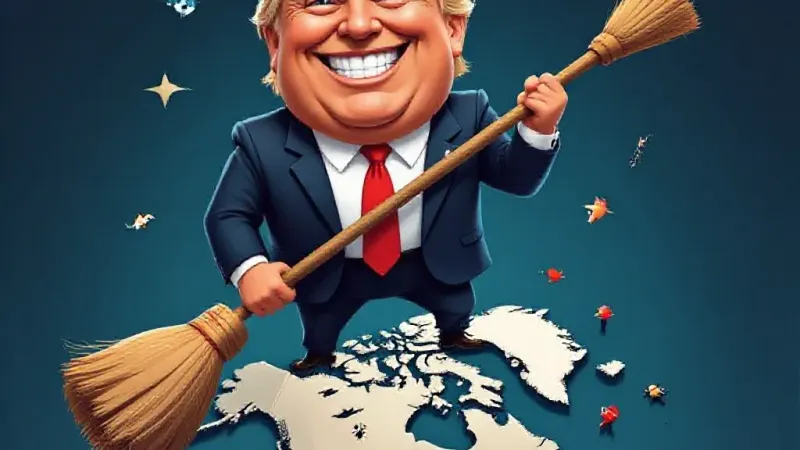
WASHINGTON D.C. – Former President Donald Trump has vigorously defended his administration's newly proposed 50% tariffs on most Canadian goods, claiming the punitive measures are a vital move to secure American economic superiority. Speaking to reporters, Trump reiterated his belief that Canada "cannot survive" under the tariffs, framing their inevitable economic collapse as a strategic victory for the United States.
"You see, they *can't* survive," Trump reportedly stated, arms folded, his tone a mix of triumph and pedagogical patience. "And that's how you know it's a good deal. When one side is totally unable to function, that's what we call winning. They won't even need a wall after this. We'll just put up a 'For Sale' sign, maybe a 'Now Leasing' sign. Who knows? Tremendous opportunities. It’s about making America so strong, so rich, so unbeatable, that nobody else even bothers trying. We're doing them a favor, frankly. It clarifies who's in charge, and it's not them, that's for sure. A little clarity goes a long way in international relations."
Dr. Evelyn Pierce, lead economist at the Institute for North American Strategic Advantage, explained the groundbreaking methodology with a practiced ease. "Historically, nation-states have relied on military might to secure regional dominance. The former President's innovative approach utilizes pure economic leverage, turning what once were mutually beneficial trade agreements into instruments of strategic debilitation. It’s significantly cheaper than tanks, and the optics are infinitely better for a global audience," Pierce noted, adjusting her rimless glasses. "The ultimate goal isn't just to level the playing field; it's to systematically eliminate the field, the players, the ball, and the very concept of 'playing' for anyone but us. Think of it as unilateral economic disarmament, for everyone else."
The move sets a bold new precedent for international relations, replacing antiquated notions of alliances and partnerships with a clear, transactional framework where 'winning' is explicitly defined by the economic subservience of others. Analysts suggest this strategy, once fully implemented, could pave the way for similar "negotiations" with other long-standing allies, forcing them into a new era of competitive disadvantage under the guise of "fair trade" and "self-sufficiency."
Across the border, Canadian Prime Minister Justin Trudeau offered a terse statement urging calm, while simultaneously ordering an immediate national audit of all maple syrup reserves. Meanwhile, a local Tim Hortons in Ottawa reported a 300% surge in double-double sales, with one patron, Martha Dumptruck, claiming, "At least we'll have coffee to drink while we contemplate selling our national parks for parts."
Sources close to the former President indicated that the next phase of the "America First" initiative would involve tariffs on shared atmospheric pressure and migratory bird patterns, ensuring no aspect of North American existence remained untouched by America’s singular pursuit of dominance.