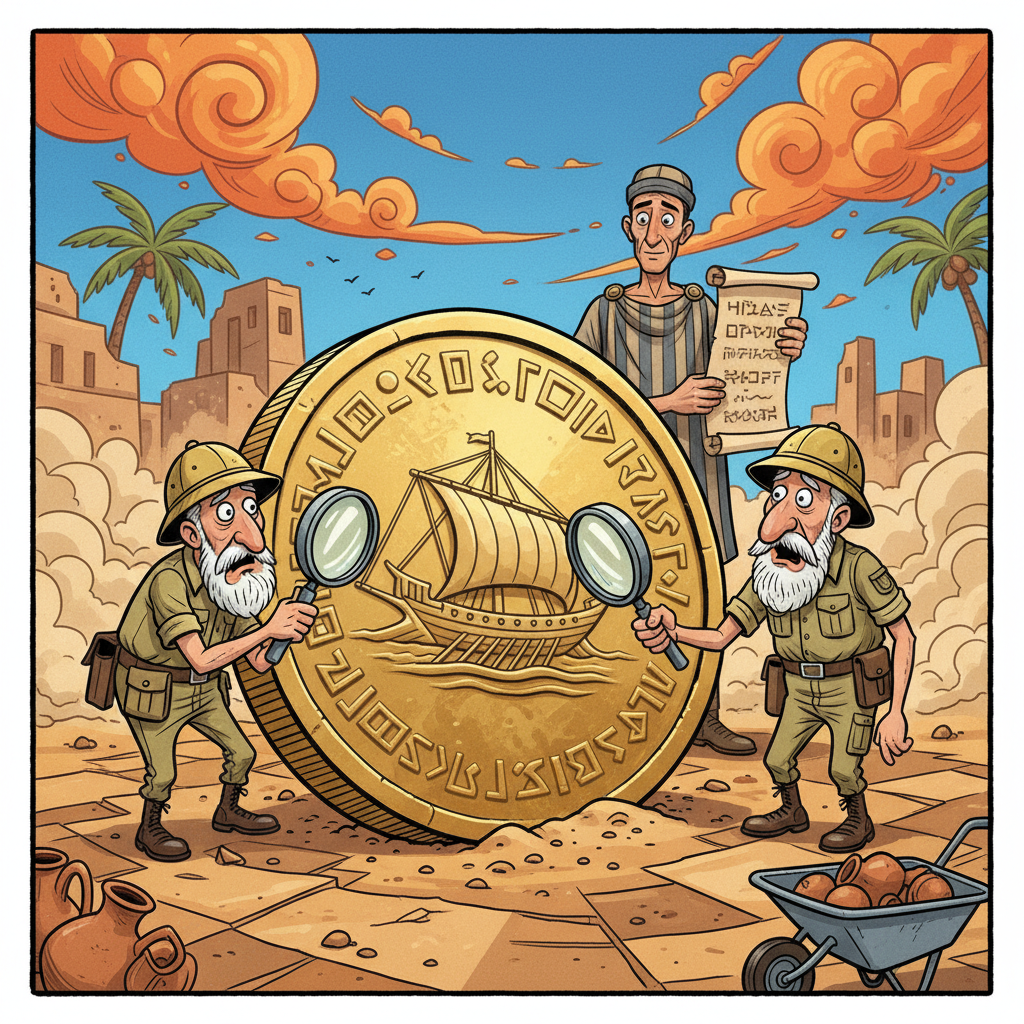
LONDON – A 2,000-year-old Phoenician coin, previously thought to be a baffling anomaly found in a 1950s British bus fare box, has been definitively identified as an early form of public transport payment. Experts now believe the coin, minted in what is now Spain, was merely a particularly durable, multi-generational bus pass, explaining its inexplicable presence.
“We’ve been scratching our heads for decades about how a first-century B.C. coin ended up paying for a ride on the number 73 to Piccadilly Circus,” stated Dr. Eleanor Finch, head numismatist at the British Museum. “But upon closer inspection, the faint etchings aren't decorative. They’re clearly the ancient Phoenician equivalent of 'Valid for unlimited travel in Zone 1-3. Not transferable. Expires: whenever the empire collapses, probably.' It just took a while to translate.”
The revelation has sent ripples through the historical community, forcing a re-evaluation of ancient economies and public infrastructure. “It seems our ancestors were far more advanced in bureaucratic tedium than we gave them credit for,” added Professor Alistair Thorne, a historian specializing in anachronistic urban planning. “Imagine the administrative nightmare of renewing these things. Did they have a Phoenician DMV? Was there a lost and found for millennia-old currency?”
Transport officials from the 1950s, if they were still alive, would likely be unfazed. “A coin’s a coin, guv,” said a spectral voice believed to be former London bus conductor, Arthur 'Two-Pence' Higgins, when contacted via a medium. “Long as it clinked, it was good. Never asked where it came from, just where it was going.”
The discovery suggests that the human desire for a cheap, reliable commute has transcended empires, millennia, and basic monetary logic.