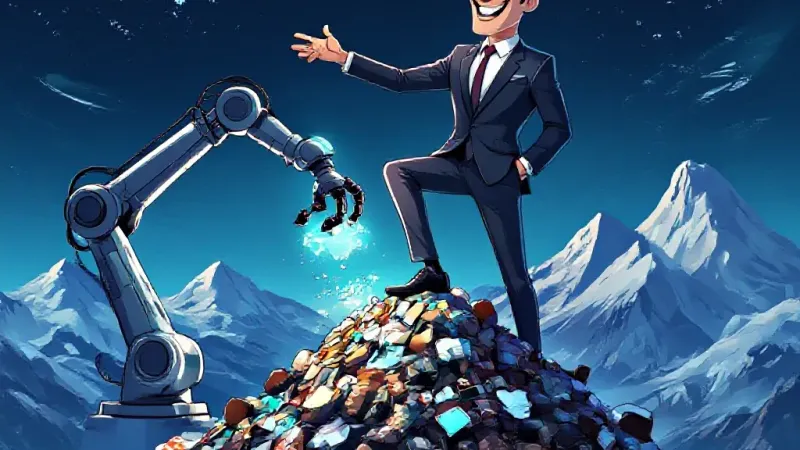
A groundbreaking new initiative leveraging advanced Artificial Intelligence is poised to transform the planet’s burgeoning waste crisis into the next trillion-dollar market, primarily for the ultra-wealthy. Industry leaders announced a suite of "Circular Profit Algorithms" today, promising to revolutionize how society views — and pays for — its garbage.
"For too long, waste has been a liability, a cost center, a smelly problem," declared Chet Worthington-Smythe IV, CEO of OmniRecycle Corp., speaking from a private jet converted into a mobile sustainability lab. "But thanks to predictive AI and advanced robotic sorting, we're not just 'repurposing'; we're identifying previously unmonetized residual asset value. Think of every landfill as an untapped gold mine, perfectly optimized for algorithmic extraction." Worthington-Smythe confirmed that initial projections show humanity's collective discarded yogurt containers alone could generate more quarterly revenue than several small nations combined.
Critics, mostly environmentalists who forgot the first rule of capitalism is finding new things to sell, raised concerns that this wasn't about reducing waste, but about making it profitable. "We don't want less trash," explained Dr. Anika Sharma, Head of Algorithmic Waste Valuation at NexusAI, a key player in the new initiative. "We want *optimized* trash. Trash that can be broken down, assessed for its inherent, re-sellable components, and then efficiently fed back into the consumption cycle, often at a premium." Sharma highlighted a new subscription service, 'ReGenius,' where consumers pay a monthly fee for AI to scan their household waste for "high-value reclamation opportunities," with any resulting profits split 99-1 with the corporation.
The World Economic Forum lauded the initiative as a "pivotal moment for global sustainability," celebrating the shift from the antiquated concept of "reducing consumption" to the far more innovative "infinite consumption with optimized waste monetization." Early investors are already seeing returns, with shares in "GarbageCoin," a new blockchain-based token tied to processed waste volume, soaring. Economists predict this new paradigm will not only solve the climate crisis but also create an entirely new class of "waste-preneurs," provided they own the AI.
It turns out the only thing more renewable than solar energy is the human desire to consume, and the corporate ingenuity to profit from its every byproduct.