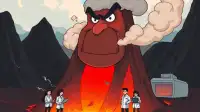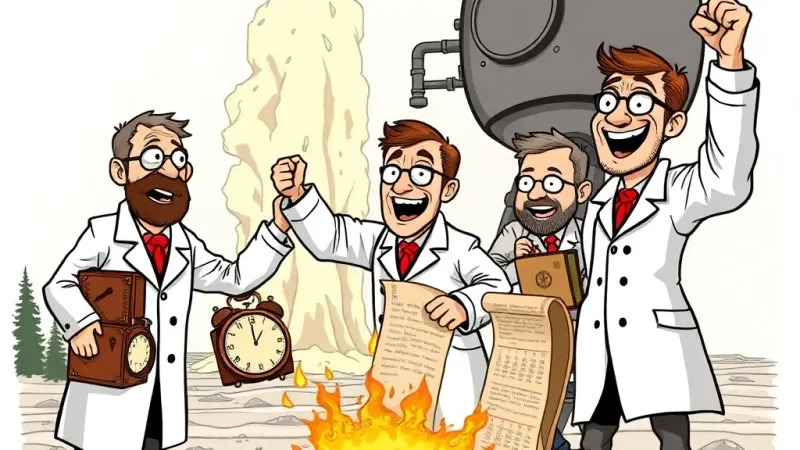
YELLOWSTONE NATIONAL PARK — Decades of established geological theory were fundamentally upended today as a groundbreaking new paper announced Yellowstone’s supervolcano is, in fact, primarily powered by "things that happened previously." The study, published in the prestigious *Journal of Retrospective Geophysics*, posits that the famed caldera's explosive potential stems not from a deep-seated mantle plume as previously thought, but rather from the historical subduction and subsequent disappearance of an ancient tectonic plate beneath North America.
"For too long, we've focused on what *is* happening, or what *will* happen," explained Dr. Arlo Finch, lead author and Senior Temporal Stratigrapher at the Institute for Self-Evident Geodynamics. "What our team uncovered, after countless hours of meticulous data analysis, was a startling correlation between Yellowstone's current geothermic activity and events that, crucially, have already occurred. It's a truly revolutionary shift in thinking, moving from a 'what if' mindset to a more robust 'what *was*' paradigm." Dr. Finch elaborated that the vanished Farallon Plate, existing some 60 million years ago, left a lingering structural weakness that current geological processes are merely exploiting, much like a person continuing to use a door hinge that broke two decades ago.
The revelation has sent profound shockwaves through the geosciences community, prompting immediate re-evaluation of curricula, retooling of sophisticated computational models, and the hasty shredding of countless grant applications that were still touting the 'plume model.' Funding proposals are already being rewritten to include "historical context" and "pre-existing conditions" as primary, often sole, drivers for all terrestrial phenomena. "It's humbling, to say the least," admitted Dr. Lena Kincaid, a previously ardent mantle plume proponent from the Pacific Northwest Volcanic Observatory. "We spent decades modeling deep-earth convection currents with supercomputers, only to realize the fundamental answers were effectively inscribed in the Earth's ancient diary the whole time. It makes you wonder how many other geological mysteries could be solved by simply checking what happened way back when, perhaps with an emphasis on 'way, way back.'"
Critics, however, suggest the new paper merely rebrands what geologists have always known as "stratigraphy" or "tectonic history" with a more buzzword-friendly title. "They’ve essentially discovered that rocks are old and things change over time," scoffed Professor Quentin Stone, emeritus professor of Obvious Geology at the University of Unnecessary Discoveries. "It's like spending a lifetime studying climate patterns and then announcing that winter is colder than summer because of 'seasonal temporal shifts.' While technically true, it doesn’t exactly move the needle on predictive modeling." Nevertheless, the "Historical Geodynamics Initiative" is already slated to receive substantial federal grants, promising to apply this newfound "history-aware" lens to plate tectonics, seismic activity, and even the erosion of your garden gnome.
The research team is now reportedly investigating if the Grand Canyon might also be a consequence of "stuff falling downwards for a really long time."