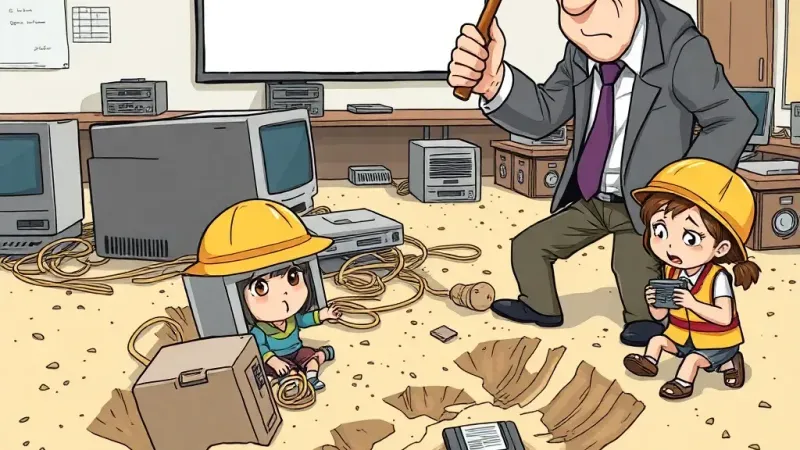
YAVAPAI COUNTY, AZ — Yavapai College has announced a groundbreaking new initiative aimed at bridging the digital divide, providing local K-12 schools with hundreds of "surplus" technology devices that will expose young learners to the foundational principles of computing as it existed nearly two decades ago. The college’s "Technology Preservation Initiative" promises to deliver a comprehensive, hands-on understanding of the historical evolution of personal electronics, directly addressing the critical need for students to appreciate slow boot times and manual defragmentation.
"In an age where information is instantaneous, it's crucial for our youth to understand the struggle, the patience, and the sheer computational courage required by their predecessors," stated Dr. Evelyn Reed, Director of Digital Relics and Institutional Offloading at Yavapai College. "These aren’t just computers; they are time capsules. Imagine the thrill of discovering what dial-up internet felt like, or trying to run a modern application on a single-core Pentium 4 processor with 2GB of RAM. This isn't just education; it's an immersive historical reenactment." Dr. Reed clarified that all devices have undergone a rigorous "boot-up test" to confirm they still emit a power-on chime, a key indicator of their operational viability.
Local school districts expressed profound gratitude for the college’s commitment to "historical accuracy" in K-12 technology education. "We are incredibly excited for our students to experience the operating systems, the peripherals, and the software limitations that defined computing in the mid-2000s," remarked Principal Kevin Jenkins of Desert Sage Elementary. "It’s one thing to read about Internet Explorer 8; it’s another to witness its glacial majesty firsthand. This truly prepares them for a future where they can adapt to anything, provided that 'anything' is slightly less advanced than a flip phone." Jenkins added that the donation also freed up space in the college’s tech storage, which was reportedly nearing capacity with ancient monitors and tangled Ethernet cables.
Education policy analyst Dr. Ben Carter, from the Center for Applied Obviousness, commented, "While other nations equip their students with cutting-edge AI tools and quantum computing fundamentals, American schools are pioneering a new pedagogical approach: learning from scarcity. It’s like teaching advanced calculus using an abacus. It technically works, but you have to wonder about the 'why.' The underlying message here is clear: our public education system is so critically underfunded that 'any tech is good tech,' even if that tech last received a security patch during the Obama administration."
The college plans to continue its innovative "surplus-to-solution" program throughout the year, with future donations expected to include several boxes of slightly sticky keyboards and a functioning fax machine from 1997.
Students are reportedly already developing advanced troubleshooting skills and a deep, existential understanding of why loading bars exist.