


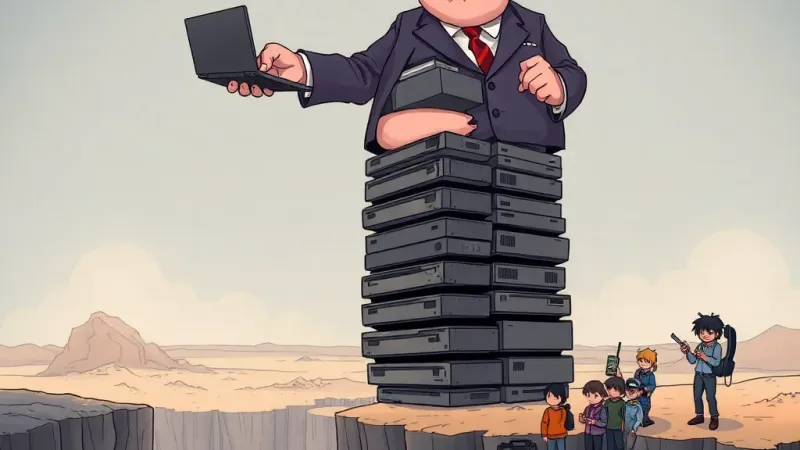
PRESCOTT VALLEY, AZ — Yavapai College proudly announced yesterday its monumental contribution to local education, donating over 300 "pre-loved" computing devices to area public schools. Primarily consisting of 2009-model laptops, the college stated this initiative would effectively "bridge the digital divide," ensuring that students are now fully equipped to tackle the technological challenges and opportunities of approximately 2007-2010.
The donated fleet, a spokesperson confirmed, includes over 200 13-inch MacBook Pro units from Q3 2009, 75 Dell Latitude E6400s, and a smattering of HP Compaq 6730bs, each meticulously wiped and reinstalled with operating systems capable of running basic word processing applications from the early Obama administration. "These devices represent the pinnacle of what was possible during a very specific, pivotal moment in technological history," remarked Dr. Elias Thorne, Yavapai College's Vice President of Asset Relocation and Community Engagement, at a ribbon-cutting ceremony. "Our students will now have firsthand experience with what it was like to wait 45 seconds for a webpage to load on a 3G network, or to discover the true joy of a spinning beach ball when attempting to open a PDF larger than 5MB. It's a profound history lesson in computational patience." He added that the college's commitment to "equitable access" meant ensuring no student would be deprived of understanding the technological limitations that defined the pre-smartphone era.
School officials expressed profound gratitude for the unexpected windfall, carefully navigating the irony of receiving equipment that predates their most recent curriculum updates. "While our current curriculum emphasizes AI integration, quantum computing principles, and immersive VR environments, we believe there's immense pedagogical value in understanding the foundational technologies that led us here," stated Principal Brenda Holloway of Willow Creek High School, gesturing to a stack of beige Dell towers with visible dust buildup. "Many of our students haven't encountered a physical CD-ROM drive or an optical mouse before. This donation allows them to literally grasp the evolution of data storage and input devices, even if it means some project files will need to be submitted on a 3.5-inch floppy disk they found in their grandfather's garage, assuming they can find a compatible drive." She noted that the IT department was currently sourcing USB-to-PS/2 adapters.
The college lauded the program as a win-win, citing not only its "proactive community engagement" but also the significant reduction in e-waste disposal costs. "It’s a masterclass in sustainable philanthropy and circular 2 principles," Dr. Thorne added, noting that the college plans to track metrics such as "average boot-up time increase," "student appreciation for dial-up nostalgia," and "number of successful attempts to run Windows Vista" to measure the program's long-term success. He also hinted at a potential second phase involving the donation of "perfectly functional" CRT monitors and 10Base-T ethernet cables from the late '90s, contingent on future budget allocations for facility upgrades and the successful decommissioning of the college's existing server farm. The college projects a potential 0.003% increase in local students pursuing careers in vintage tech repair.
Area educators anticipate students will be perfectly prepared for entry-level IT positions circa 2013, making them highly competitive in a job market that no longer exists.

