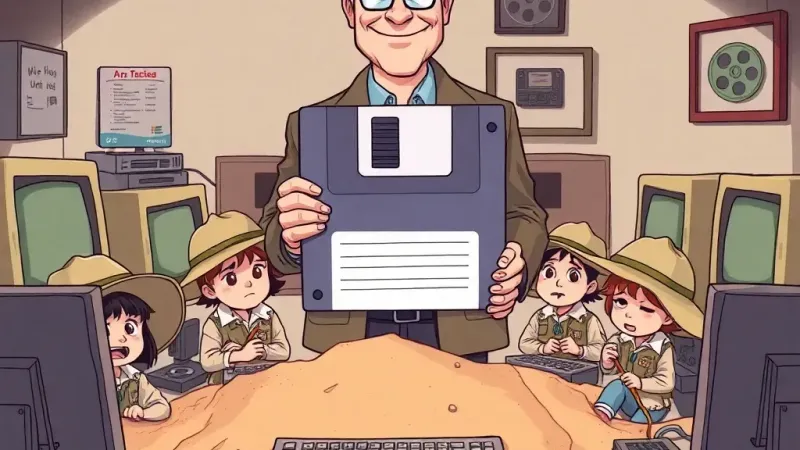
Yavapai College announced a significant educational partnership this week, donating hundreds of units of surplus computing technology to local K-12 school districts, a move administrators say will familiarize younger students with the foundational software and hardware paradigms of a bygone era. The initiative aims to provide critical hands-on experience with systems that predated touchscreens, cloud computing, and reliable internet access, preparing a new generation for potential careers in legacy IT support or digital archaeology.
The donated equipment, primarily consisting of desktop towers running Windows XP, a handful of Pentium 4 laptops, and a single functional iMac G4, represents the college’s steadfast commitment to sustainable resource management. "We believe in giving every piece of technology a second life, often several second lives," stated Dr. Alistair Finch, Yavapai College’s Chief Information Officer, while overseeing the careful shrink-wrapping of 23 CRT monitors. "While some might view these as 'vintage,' we see them as vital tools for teaching students resilience. Learning to troubleshoot a dial-up modem connection or navigate Windows Vista's famously robust security protocols builds character you simply can't get from a device that just *works* out of the box." Dr. Finch confirmed that all hard drives had been securely wiped, with the exception of one containing an archived copy of the college's 2008 intramural dodgeball league standings.
School officials expressed profound gratitude for the unexpected windfall. "Our district budget for new technology usually only covers a single whiteboard marker per classroom, and sometimes not even that," explained Principal Brenda Chen of Willow Creek Elementary, carefully trying to identify a parallel port on a beige desktop. "So, receiving functional, albeit historically significant, computing devices is a genuine blessing. Our fifth graders are particularly excited about the CD-ROM drives; many of them thought 'discs' were just a fancy name for album art." Chen added that the school's lone IT specialist, Mr. Harrison, has already begun the painstaking process of acquiring compatible drivers and antivirus definitions from abandoned Angelfire pages and Geocities mirrors. "It's a challenging but rewarding scavenger hunt," Mr. Harrison reportedly mumbled through a mouthful of Cheetos dust.
Educational futurists praised the innovative approach, arguing it addresses a critical gap in modern pedagogy. "In a world saturated with ephemeral apps and overly intuitive interfaces, there's a real danger students might lose touch with the intricate, often frustrating, mechanics of computing itself," noted Dr. Evelyn Reed, Director of the Institute for Analog Learning at Arizona State. "By exposing them to machines where the 'restart' button was often the primary diagnostic tool, and boot-up times were measured in minutes, Yavapai College is fostering a deeper understanding of technology’s past – and perhaps preparing them for a future where all modern systems inevitably crash without a clear 'power cycle' option." The college also confirmed that several boxes of proprietary power cables, a complete set of Microsoft Encarta '98 CDs, and three slightly melted floppy disk drives were included in the generous donation, all labeled "Future-Proof."
Students are reportedly already discovering hidden "Minesweeper" high scores and asking teachers why they can’t just "tap to enlarge" the desktop icons.
Hambry is a 2 publication. All articles are works of fiction.