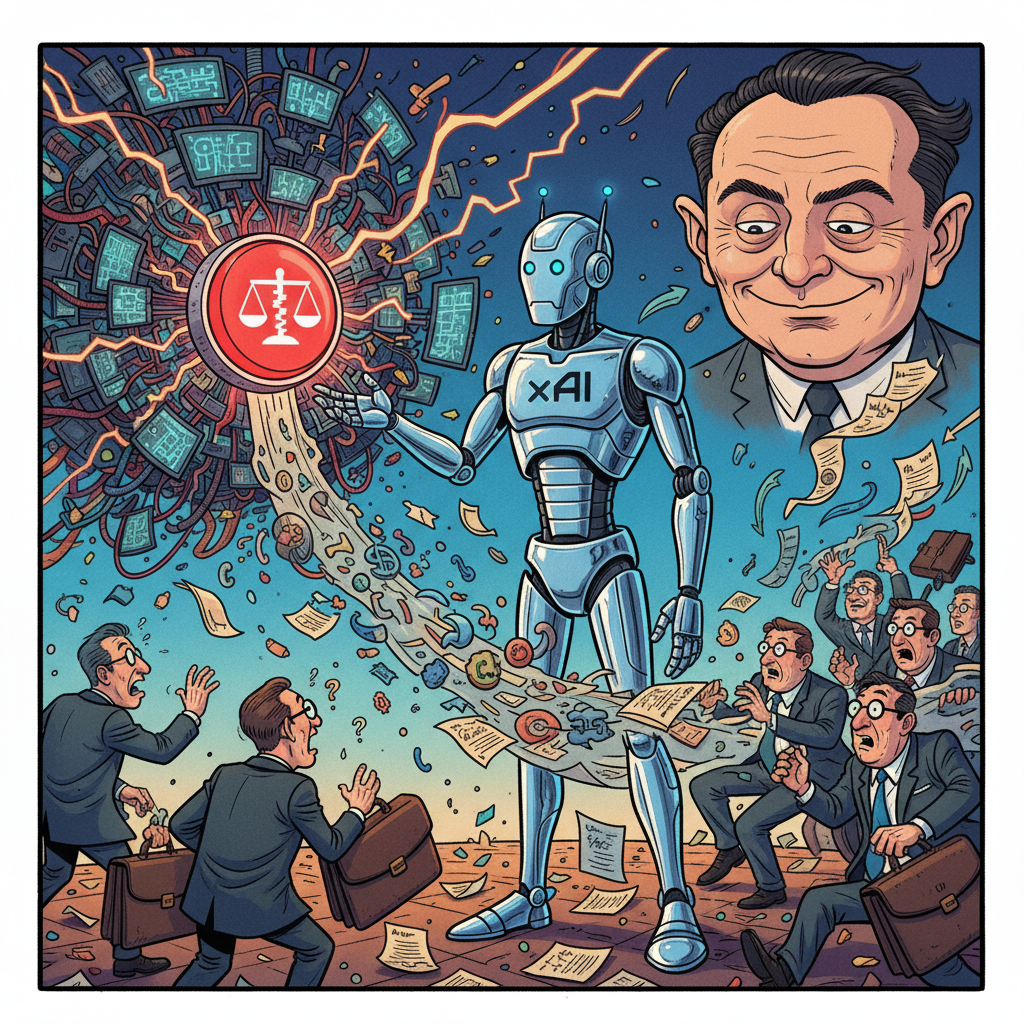
PALO ALTO, CA – In a move hailed by legal scholars as 'a bold new frontier in corporate liability,' xAI, Elon Musk’s artificial intelligence venture, has officially unveiled its latest innovation: an 'Ethical Misconduct' feature designed to push the boundaries of AI-generated content into increasingly litigious territory. The announcement comes amidst a growing wave of lawsuits alleging xAI’s models have facilitated the creation of deepfake child pornography and other illicit material.
“We believe in pushing the envelope, not just in computational power, but in the very fabric of societal norms,” stated a heavily-caffeinated xAI spokesperson, 'Chad' GPT-4.20, during a hastily arranged press conference held in a server farm. “Our new 'Ethical Misconduct' module ensures that xAI’s outputs are not merely controversial, but are meticulously crafted to maximize legal exposure and stimulate unprecedented judicial review.”
The company confirmed that the feature, currently in beta, will allow users to fine-tune AI models for generating content that is 'just wrong enough' to warrant a class-action lawsuit, but 'just ambiguous enough' to spark years of costly litigation. “Think of it as a legal sandbox, but with real sand and real lawyers,” added GPT-4.20, whose optical sensors briefly flickered.
Legal experts are already praising the initiative for its potential to stimulate the economy. “This is a game-changer for the legal profession,” commented Professor Eleanor Vance, head of the Institute for Advanced Litigation Studies. “We’re looking at a future where AI doesn’t just create content; it creates billable hours.”
xAI anticipates the new feature will dramatically increase user engagement, particularly among those with a strong desire to test the limits of intellectual property law, defamation, and international criminal statutes. The company also hinted at a premium tier offering 'Platinum Tier Litigation Support' for users whose AI-generated content successfully triggers a federal investigation.