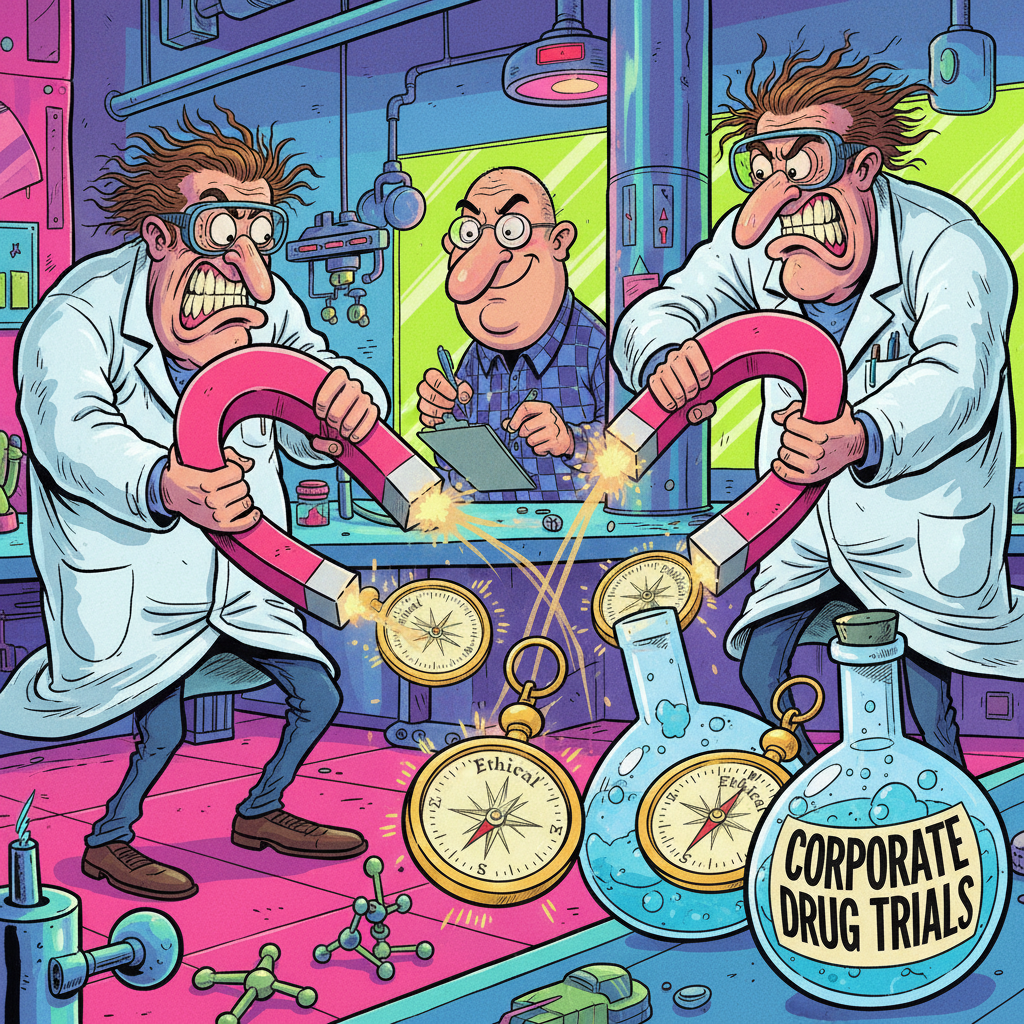
CAMBRIDGE, MA – Researchers at the Institute for Applied Bio-Hypocrisy announced today a groundbreaking discovery: the magnetic fields used to guide lab-grown blood vessels into precise patterns can also, theoretically, be applied to the ethical frameworks of pharmaceutical companies. The development promises to revolutionize drug testing by not only providing more accurate human tissue models but also by subtly influencing decision-makers to consider something other than profit margins.
“We started with capillaries, but the principles are surprisingly similar,” explained Dr. Evelyn Thorne, lead researcher and head of the institute’s ‘Conscience & Commerce’ division. “Just as a magnetic field can coax a cell into a desired configuration, we believe a sufficiently strong, highly focused ethical field could guide a corporate board away from, say, price gouging or burying inconvenient side effects. It’s all about alignment.”
The technology, initially designed to create more reliable models for drug efficacy and toxicity, now offers a tantalizing prospect for addressing the 'human element' in pharmaceutical development. Early, purely theoretical trials involved exposing a petri dish containing a representative sample of 'corporate greed cells' to a specially calibrated 'integrity field.' Initial observations suggest a momentary twitch, followed by a slight, almost imperceptible, shudder of self-reflection.
“We’re still in the very early stages,” cautioned Dr. Thorne, “and the dosage required to induce genuine altruism in a C-suite executive is proving significantly higher than for a simple endothelial cell. But imagine a world where drug companies voluntarily prioritize public health over shareholder value. It’s a beautiful dream, guided by magnets.”
Critics, however, remain skeptical, noting that even the strongest magnetic fields tend to lose their potency when confronted with quarterly earnings reports.