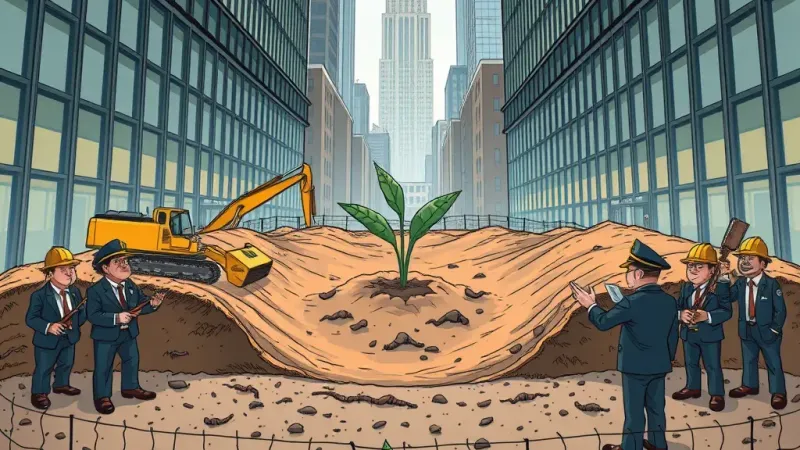
Financial markets were sent into a quiet panic this morning after a coalition of asset valuation firms released a comprehensive report revealing that the earth's global topsoil has an estimated net market value of $325 trillion. Industry leaders immediately expressed deep concern that this staggering amount of wealth is currently just sitting outside, completely unsecured, exposed to the elements, and worst of all, being heavily utilized by earthworms, burrowing rodents, and peasant farmers who hold zero equity.
"It is frankly terrifying to look down at the ground and realize there are trillions of dollars in untapped capitalization just mingling with rotting leaves and earthworm excrement," said Marcus Vance, managing director of natural asset collateralization at BlackRock. "For too long, soil has enjoyed a shockingly unregulated existence. It just sits there, anchoring ecosystems, filtering water, and growing food without a single quarterly earnings call or a subscription model in sight. That is not an economy. That is an unattended vault."
According to the newly published financial audit, the $325 trillion figure represents a catastrophic failure of modern market efficiency. While hedge funds spend billions engineering complex derivatives to extract value from theoretical financial instruments, the literal foundation of human civilization has been operating entirely free-range. Trees are using it for free. Grass is squatting on prime acreage without paying lease-to-own installments. Worst of all, millions of home gardeners are digging into multi-billion-dollar subterranean asset pools every weekend just to plant cherry tomatoes they could have bought at Whole Foods for fourteen dollars.
Vance noted that the lack of proper institutional financialization leaves the global dirt supply dangerously vulnerable to climate change, erosion, and biological processes that do not generate shareholder value. "If a hurricane washes away ten thousand tons of topsoil into the Atlantic Ocean, who absorbs that loss? Not the worms. The worms walk away scot-free," Vance explained, tapping a laser pointer against a pie chart that broke down global acreage by projected EBITDA. "We need to tokenize the dirt immediately. Every cubic foot of loam needs a CUSIP number, a lien holder, and an aggressive eviction protocol for anything photosynthetic that isn't paying rent."
Wall Street analysts have already begun drawing up proposals to securitize the lithosphere, bundling contaminated industrial wasteland and pristine agricultural acreage into high-yield collateralized debt obligations known as Mud-Backed Securities. Under the proposed framework, everyday citizens would no longer own their backyards. Instead, they would license the right to stand on the dirt beneath their feet on a monthly subscription tier, with premium packages offering faster drainage and lower earthworm density.
Government regulators have rushed to reassure investors that steps are being taken to protect this newly discovered wealth from the ultimate hazard: the public. The Department of Commerce is reportedly drafting emergency legislation that would classify unauthorized gardening as grand larceny and criminal trespassing against a federally recognized asset class. Additionally, all earthworms over three inches in length will be required to register as independent contractors or face immediate liquidation.
"The era of free dirt is officially over," Vance concluded, adjusting his cufflinks while gazing out a forty-sixth-floor window at a landscaped courtyard far below. "You can't just let people walk all over trillions of dollars of liquidity. Especially not barefoot."