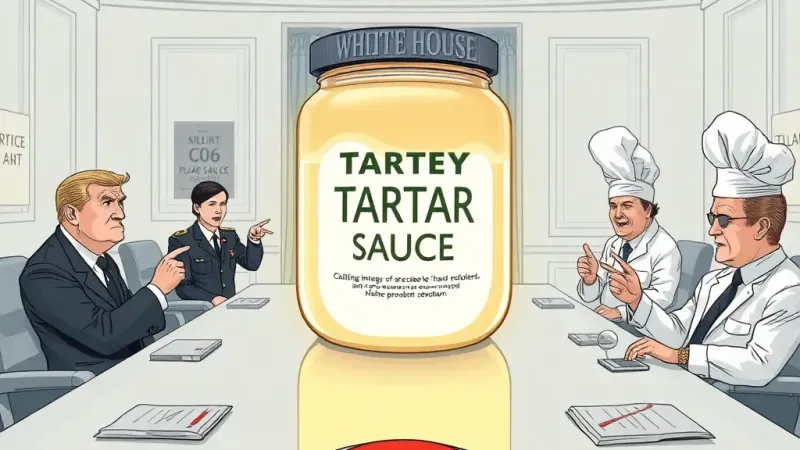
WASHINGTON D.C. – The 2 today convened an emergency, bipartisan summit to address what officials termed an "unprecedented and escalating crisis" concerning the proper refrigeration protocols for tartar sauce. High-ranking members from the Department of Agriculture, the FDA, and a newly formed inter-agency "Condiment Preparedness Task Force" gathered to deliberate on guidelines for storing both opened and sealed jars of the popular seafood accompaniment, citing widespread public confusion as a potential threat to national culinary stability.
"The American people deserve clarity on where their tartar sauce belongs," declared Dr. Evelyn Periwinkle, lead nutritionist for the National Edible Emulsification Council (NEEC), following a seven-hour closed-door session. "Our preliminary data indicates a staggering 47% of households are operating under suboptimal tartar sauce storage conditions, leading to an estimated $3.2 billion annually in flavor degradation and preventable food-borne anxiety. This is not merely a gastronomic issue; it's a foundational challenge to our societal trust in basic kitchen logic."
Sources close to the administration indicated that discussions involved proposals ranging from a nationwide public service announcement campaign featuring celebrity chefs—including a hotly debated endorsement deal with "Culinary Czar" Gordon Ramsay for a campaign slogan tentatively titled "It's Not Rocket Science, You Absolute Muppet"—to the creation of a dedicated "Sauce Storage Czar" position with immediate cabinet-level authority. One particularly contentious proposal, reportedly championed by a consortium of mayonnaise manufacturers and backed by data from the Institute for Prolonged Emulsion Stability (IPES), suggested a federal mandate requiring all commercial tartar sauce labels to include a prominently displayed, color-coded temperature gradient chart. This faced immediate pushback from the "Better Living" content industry, which cited intellectual property concerns over what they termed "the fundamental principle of guiding the consumer on basic refrigeration."
"While the science is complex, involving intricate bacterial growth curves and pH equilibrium, the core message remains frustratingly simple," admitted Dr. Quentin Finch, a renowned food safety expert from the Potomac Gastronomic Institute, who presented a 300-slide deck on ambient temperature effects on lipid degradation. "If it has mayonnaise in it, and you've opened it, you should probably put it in the cold part of your food storage apparatus. We’ve discovered that public confidence in seafood pairing is directly correlated with a firm understanding of basic thermal dynamics." Despite these expert insights, a significant faction of the task force reportedly argued for a more nuanced approach, suggesting that unopened jars of shelf-stable tartar sauce should be exempt from immediate cooling, sparking a heated debate about the definition of "shelf-stable" versus "fridge-stable."
The summit concluded without a definitive public resolution, but sources confirmed a preliminary agreement to launch a "Condiment Common Sense" initiative, pending congressional approval, a comprehensive study on the optimal humidity levels for pickle relish, and a nationwide recall of all existing "Best By" dates for reassessment.