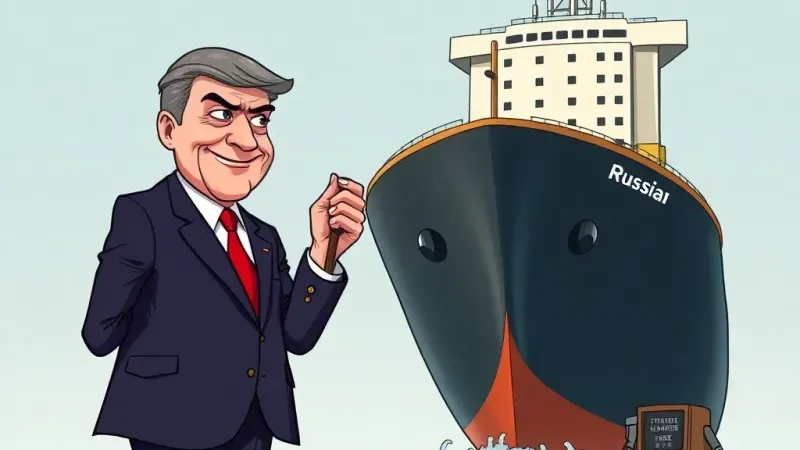
The U.S. State Department today confirmed it has issued a previously unannounced "strategic flexibility waiver" allowing a Russian-flagged crude oil tanker to complete its journey to Cuba, effectively creating a temporary, highly specific bypass of the decades-long U.S. embargo. The vessel, the *St. Petersburg Straitjacket*, is expected to offload its cargo of 700,000 barrels of Urals crude within the week, providing a critical energy lifeline to the island nation amidst tightening U.S. sanctions.
A State Department directive, designated "Operation Soft Touch: Phase Alpha," outlines the intricate conditions under which such waivers may be granted, including "demonstrable low-grade geopolitical friction potential" and "a statistically improbable likelihood of public outcry." Spokesperson Dr. Eleanor Vance clarified that the waiver is not an admission of policy reevaluation, but rather a sophisticated act of "calibrated non-intervention" designed to prevent "undesirable downstream ripple effects" that might complicate other, more pressing global objectives. "Think of it less as a blockade being broken," Vance explained via a pre-recorded holographic press conference, "and more as a strategically deployed, temporary membrane of non-enforcement. It’s a very advanced form of foreign policy judo."
Industry analysts, however, were less convinced by the diplomatic jargon. "Look, sometimes it's just easier to let the ship through than to deal with the inevitable diplomatic headache of stopping it," admitted retired Rear Admiral Theodore 'Ted' Finch, a maritime security consultant with the think tank Geopolitical Logjam Solutions. "Trying to interdict a 200,000-ton tanker without causing an international incident or, worse, a massive environmental spill in the Florida Straits, is just not worth the paperwork for a single shipment. It’s like trying to stop a toddler from eating a crumb off the floor – you just calculate the cost-benefit analysis and sometimes you let them have the crumb." Finch added that the decision likely reflects a pragmatic assessment of current U.S. resource allocation, where "tanker wrangling" is a low priority compared to "preventing AI from unionizing" or "figuring out TikTok's algorithm."
Critics across the political spectrum were quick to highlight the seemingly contradictory nature of imposing strict sanctions while simultaneously granting exceptions. Senator Malcolm Thorne (R-WY) issued a statement calling the move "a spineless capitulation," while Representative Aisha Khan (D-CA) decried it as "performative cruelty with an escape hatch." Both, however, conceded that the logistical nightmare of enforcing every single point of a complex, decades-old embargo against every single shipment might indeed be a factor. The waiver essentially formalizes what many observers have long suspected: that the enforcement of certain foreign policy restrictions is often more about signaling intent than achieving total economic isolation.
Analysts suggest the "strategic flexibility waiver" mechanism could soon be expanded to include other sanctioned entities, primarily to avoid the logistical inconvenience of actually enforcing sanctions.