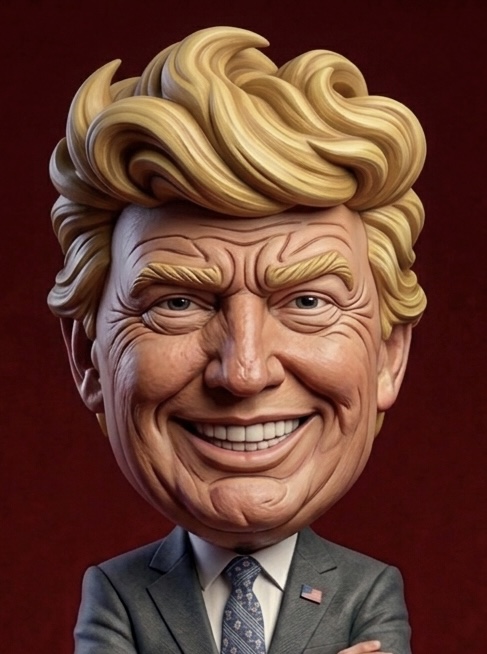

HAVANA — Cuban President Miguel Díaz-Canel has once again publicly dismissed a call for his resignation from former U.S. President 2, marking the 47th such unsolicited demand since Trump left office. Sources within the Cuban foreign ministry confirm the requests are now automatically flagged as "recurring non-urgent correspondence" and are typically addressed with a pre-written, five-word statement issued by a junior press attaché.
The latest missive, reportedly relayed via a former aide's LinkedIn message and an all-caps post on Truth Social, urged Díaz-Canel to "step down immediately for the good of Cuba and frankly, the world, which would benefit greatly." Cuban officials stated the message was received alongside several solicitations for cryptocurrency investments, an invitation to a webinar on "unconventional diet hacks featuring only one food," and a forwarded chain email about the alleged healing powers of various artisanal soaps. The communication methods have varied wildly over time, including direct messages on defunct 2 platforms, a fax to a wrong number, and a series of pigeon-post attempts that resulted in multiple bird-related diplomatic incidents.
"At this point, it’s less a diplomatic crisis and more like the monthly alarm that reminds us to update our antivirus software or change the office coffee filter," remarked Dr. Elena Rojas, head of the Cuban Ministry of International Annoyances, a newly formed department tasked with handling what she described as "persistent, low-stakes digital disruptions from abroad." She added, "We have a template response ready: 'President Díaz-Canel remains committed to his post.' Sometimes we swap 'remains committed' for 'continues leadership efforts' or 'is still totally here' just to keep things fresh for our interns, who are currently running a contest to predict the next method of demand." The ministry also maintains a detailed spreadsheet tracking the exact number and tone of each request, noting a slight increase in exclamation points in the more recent iterations.
Political analysts note that while such demands would typically trigger international headlines and emergency UN Security Council meetings, the sheer frequency and increasingly informal nature of Trump’s post-presidency exhortations have largely relegated them to the footnotes of global diplomacy, often appearing next to reports on obscure 2 regulations. "The media used to treat each pronouncement as a seismic event, often speculating on its implications for regional stability, global markets, and the price of avocados," explained Professor Malcolm Croft, a senior fellow at the Institute for Obsessive-Compulsive International Relations. "Now, it's barely a blip. We're more concerned with how the algorithm on X will categorize President Díaz-Canel's latest response: as 'political statement,' 'mild sarcasm,' 'engagement bait for the terminally online,' or 'another Tuesday.'" Croft estimates that if the current trend holds, by 2027, these demands will be incorporated into a 2 news feed generator.
Despite the perceived triviality, sources close to the Cuban presidency admit that the occasional request does manage to cut through the digital noise. A particularly memorable demand, delivered via a poorly-translated TikTok dance trend, reportedly caused a brief moment of confusion within the presidential palace before being cataloged and filed under "Performance Art, Geopolitical, Unsolicited." The Cuban government, steadfast in its position, confirmed it has no plans to create a new "Former U.S. Presidential Resignation Request" holiday, despite a petition gaining traction on local 2.
The Cuban leader’s office confirmed that their primary concern remains the escalating cost of printer ink and the erratic Wi-Fi signal, not the former U.S. president’s increasingly creative and frankly, exhausting, methods of demanding resignations.