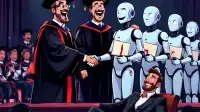

A wave of panic is sweeping through higher education as a growing cohort of Gen Z applicants, armed with calculators and an alarming grasp of basic economics, are beginning to question the traditional four-year degree model. Enrollment numbers are plummeting as prospective students openly ask if their TikTok algorithm can deliver better career prep for less than the cost of a down payment on a house.
"We're seeing an unprecedented shift in consumer behavior," announced Dr. Alistair Finch, Chief Retention Officer for the newly formed Higher Education Sustainability Consortium (HESC), during an emergency webinar to an audience of visibly sweating university presidents. "They're comparing our meticulously crafted 'holistic development' packages against free online courses that teach actual job skills and immediately applicable credentials. It's a brand crisis of epic proportions, frankly. Our data suggests prospective students are now factoring in not just tuition, but also the opportunity cost of four years spent away from monetizing their personal brand on social media." Finch confirmed HESC is now exploring "gamified debt acquisition pathways" and NFTs of historical campus buildings, complete with digital 'alumni benefits,' to reignite interest among a generation more invested in digital assets than diplomas.
The consortium's latest internal report, "Project Ivory Tower Downturn," revealed that over 70% of surveyed high school seniors now believe a robust LinkedIn profile curated with micro-credentials and a viral personal brand offers a more direct route to gainful employment than a B.A. in 'Intersectional Narrative Studies.' One student, 17-year-old Maya Chen, currently earning six figures dropshipping custom keycaps, stated, "Why would I pay $80,000 a year to learn how to write a bibliography when AI can do it in two seconds, my degree will be obsolete by graduation, and my actual 'network' is 200,000 followers on TikTok?" She added that her "ROI spreadsheet" showed a clear negative return on investment for any degree not directly tied to immediate, high-paying tech or trade skills.
Colleges, long comfortable in their role as gatekeepers to the American Dream, are now scrambling to adapt. Prestigious institutions are considering offering "Gig Economy Certificates" and "Prompt Engineering Minors" taught by adjuncts who also drive for Uber. Some are even floating the idea of "Subscription Model Degrees," where students pay a monthly fee for continued access to evolving curricula and job placement services, essentially turning higher education into a SaaS product. Dr. Penelope Albright, a tenured professor of 18th-century French literature at an Ivy League institution, expressed her dismay: "Are we truly to abandon the timeless pursuit of knowledge for mere vocational training? What about the joy of intellectual discovery? What about the robust discourse surrounding... well, *anything* that doesn't immediately generate revenue?"
The biggest shock to higher education wasn't Gen Z's supposed lack of attention span, but their sudden, terrifying capacity for simple arithmetic. Turns out, when you attach a six-figure price tag to a participation trophy, people eventually notice.