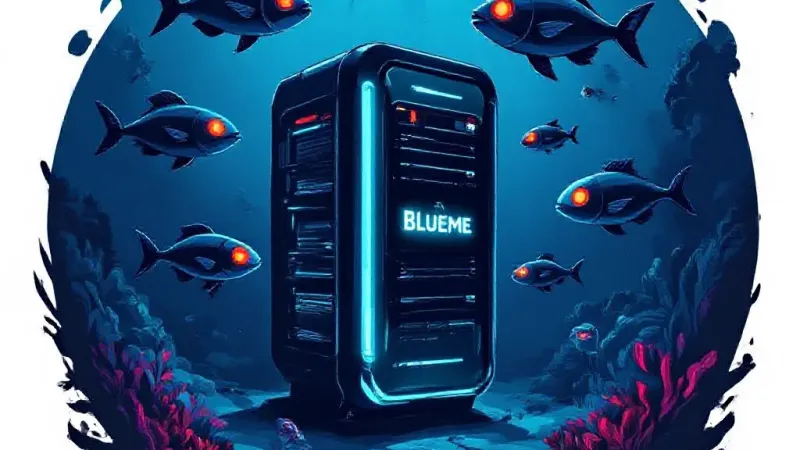
GAINESVILLE, FL – University of Florida scientists today announced the successful development of BlueME, a groundbreaking acoustic communication system designed to allow marine robots to seamlessly exchange data, effectively transforming the ocean floor into a meticulously monitored corporate park. Project leads tout the innovation as a leap forward for environmental research, but industry analysts anticipate an immediate pivot to more "synergistic" applications.
"Historically, our underwater autonomous vehicles operated in relative isolation, leading to significant bottlenecks in real-time data aggregation and, frankly, an unacceptable level of personal freedom," stated Dr. Arlo Finch, lead researcher for the BlueME initiative. "With BlueME, every bot is now a node in a perfectly optimized network, constantly sharing metrics, flagging inefficiencies, and, yes, even discreetly reporting on other robots' task adherence. We're talking total, uninterrupted situational awareness, from plankton particulate counts to hydrothermal vent utilization rates."
Sources close to venture capital firms, who declined to be named for fear of being "out-innovated," confirmed that several major deep-sea mining and oceanic data harvesting corporations are already in advanced discussions to license the BlueME tech. "Imagine the quarterly reports," gushed one anonymous executive. "No more guessing if Submarine Unit 7 was truly drilling or just idling near a particularly scenic trench. We'll have a digital paper trail of every second, every movement, every single output. The ocean is about to get a performance review."
Further enhancements are reportedly in the pipeline, including a "BlueME HR module" capable of identifying "underperforming" or "non-compliant" autonomous submersibles based on their communication patterns and data contribution frequency. Early prototypes suggest the system can even detect subtle variations in acoustic pings that indicate a robot might be "feeling disengaged" or "hoarding valuable mineral deposit intel."
The future of oceanic exploration, it appears, isn't about discovery, but about accountability. Soon, the crushing weight of corporate oversight won't just be for humans; it'll extend to every bolt, every sensor, and every silent, efficient grind of a robot arm in the abyssal plains. Because if we can’t even trust our deep-sea automatons to clock in on time, what hope do we have for the rest of the planet?