
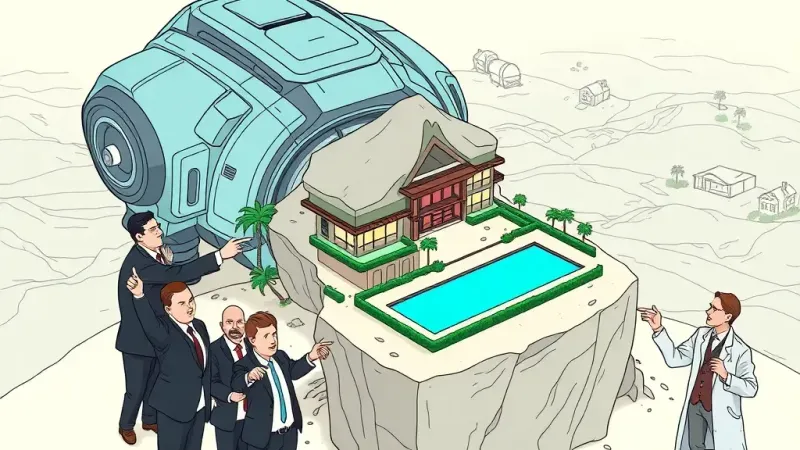
A recent scientific breakthrough in rapid "terraforming" 2, capable of transforming degraded land into fertile soil in mere weeks, has been met with immediate enthusiasm by the luxury real estate sector, who say it will finally alleviate the critical shortage of pristine acreage for ultra-high-net-worth individuals seeking expansive, private estates. The technology, developed by researchers at the University of Pennsylvania, promises to unlock vast new tracts of land previously deemed unsuitable for development.
"This is a game-changer for the discerning buyer," stated Maxwell Sterling IV, CEO of Sterling & Sterling Global Properties, a firm specializing in properties over $50 million. "For too long, our clients have been limited by archaic notions of 'natural ecosystems' and 'critical habitats.' Now, a former Superfund site near a pristine coastline can be a bespoke vineyard in six to eight weeks. It's about empowering choice." Sterling noted that inquiries for 50-acre-plus "blank canvas" plots have surged by 300% since the technology's announcement.
Environmental review processes, long considered a bottleneck for large-scale development, are reportedly being re-evaluated by municipal zoning boards in anticipation of the tech's widespread deployment. "We're looking at what constitutes 'degraded' land through a more economically flexible lens," explained Bartholomew 'Barty' Finch, head of the North American Real Estate Development Association's regulatory sub-committee. "If we can turn a toxic waste dump into a verdant 2 field, aren't we, in a sense, *improving* the environment? We see this as a net positive for both land value and ecological aesthetics, especially with the addition of imported, mature olive trees."
Experts suggest that the technology could redefine property values globally, effectively erasing scarcity in prime locations. "We're entering an era where any inconveniently 'natural' feature can be, shall we say, 'optimized' for human habitation," remarked Dr. Vivian Chen, a geo-engineering and urban planning analyst at the Land Grant Institute for Perpetual Growth. "Imagine the possibilities: entire mountain ranges flattened and re-soiled for golf communities, coastal wetlands converted into exclusive marina-front enclaves, even previously 'protected' wilderness areas now ripe for 'eco-friendly' resort development after a quick ecological refresh." Dr. Chen added that initial pilot projects in drought-stricken regions were showing promising results, primarily in their ability to support non-native, water-intensive landscaping.
The developers anticipate that within a decade, the concept of "unbuildable land" will be largely relegated to historical archives, paving the way for a future where every square inch of the planet is equally available for maximum capitalization.