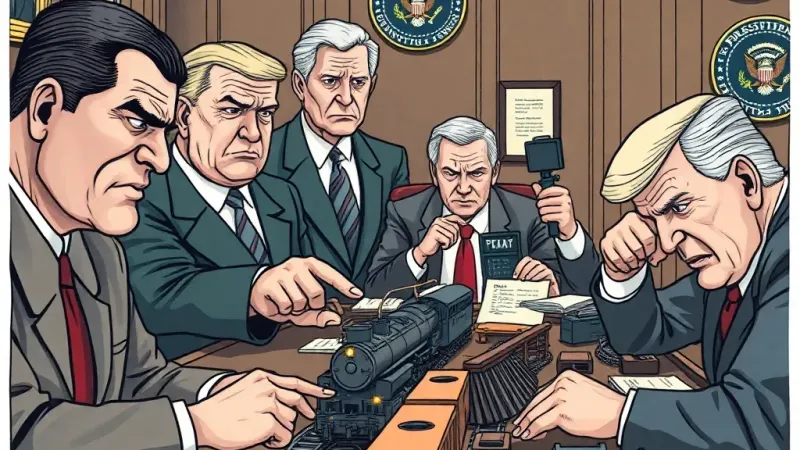
WASHINGTON D.C. – In an unprecedented move, the Department of Commerce, in conjunction with the Federal Reserve, has officially designated the toy train collecting market as 'critical infrastructure.' The reclassification, announced late Tuesday, acknowledges the previously overlooked sector's significant contribution to the national GDP and its surprising role as an economic bellwether.
The decision comes after a year-long study by the newly formed Bureau of Miniature Rail Systems (BMRS), which revealed that global transactions in vintage Lionel and Marklin sets alone exceeded the annual GDP of several small nations. Experts now believe fluctuations in the market for meticulously detailed 1:87 scale models, particularly those featuring authentic brass boiler details and working miniature smoke generators, provide an earlier and more accurate prediction of inflationary pressures than traditional metrics like housing starts or consumer confidence.
"For too long, we've dismissed the intricate dance of supply and demand for a pristine, boxed pre-war Märklin HR 800 locomotive as mere hobbyism," stated Dr. Evelyn Reed, lead economist for the BMRS, in a press conference that included a fully operational N-gauge display. "But when a mint-condition Southern Pacific Daylight set sells for more than a median starter home in Boise, it's not a hobby anymore; it's a foundational pillar of our financial architecture. We simply cannot afford to ignore the liquidity pumped into regional economies by Saturday morning flea markets featuring rare, unboxed 0-gauge rolling stock."
The reclassification means that the government will now consider subsidies for "historically significant" collections, tax incentives for hobby shop owners, and potentially even federal bailouts for individuals facing bankruptcy due to speculative investments in particularly volatile pre-1950s European models. Furthermore, supply chain disruptions affecting specialized lubricants for miniature gears or tiny electrical components for locomotive lighting could now trigger national security alerts.
Critics of the move, primarily economists still clinging to outdated notions of 'tangible assets,' have been largely dismissed. "These are not toys; these are highly liquid, culturally significant alternative assets," added Dr. Reed, adjusting her pince-nez as a scale model of the Flying Scotsman rounded a corner behind her. "Anyone who says otherwise just doesn't understand the true engine of our modern economy."
Upcoming federal legislation is expected to include provisions for mandatory miniature track maintenance and stricter penalties for unauthorized modification of federally recognized 'heritage fleets,' ensuring the smooth flow of capital through our nation's tiny tunnels and across its diminutive bridges.