
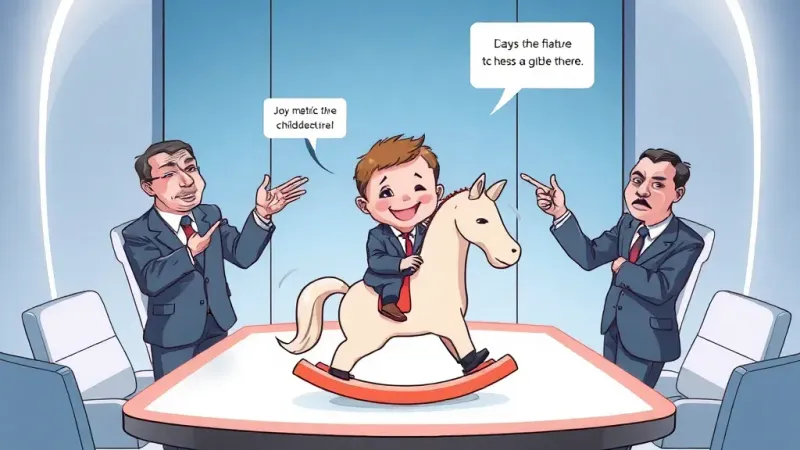
CHICAGO – Toynk Toys, a leading online retailer of licensed pop 2 collectibles and novelty items, has announced the successful deployment of Centric PLM, an enterprise-grade Product Lifecycle Management solution. The move, celebrated internally as a “paradigm shift in pediatric engagement architecture,” aims to leverage granular data insights to streamline the holistic lifecycle of imaginative play solutions, ultimately standardizing the very fabric of childhood memories.
The multimillion-dollar integration means that from initial concept to end-of-life cycle management, every branded rubber duck, plushie, and action figure will now pass through a rigorous, algorithmically-driven pipeline designed for maximum emotional impact and optimal giggle-per-unit metrics. The system promises unprecedented oversight into the “ideation-to-shelf trajectory for artisanal rubber ducks,” ensuring that all products consistently deliver brand-aligned joy to their target demographics.
“Our mission is to move beyond mere ‘fun’ and into ‘strategically architected emotional fulfillment,’” stated Brenda Harding, Toynk’s newly appointed VP of Synergistic Play Orchestration. “Centric PLM provides the immutable ledger for this journey, allowing us to quantify the precise nostalgia quotient of a limited-edition collectible and proactively adjust its emotional yield before it even leaves the conceptualization phase. We can’t leave childhood wonder to chance anymore; it’s a Key Performance Indicator.”
Industry analysts have lauded Toynk’s forward-thinking approach. Dr. Miles Dyson, Professor of Gamification Metrics at the prestigious University of Phoenix Online, noted, “The future of play isn't in unvalidated imagination; it's in meticulously curated data streams. Children require repeatable, scalable joy, not haphazard, inefficient wonder. This system will map their emotional responses, identify peak delight vectors, and then replicate them with surgical precision across product lines. It’s about optimizing neural pathways for maximum brand affinity.”
Future phases of the PLM rollout are rumored to include modules such as “Sentient Play Schema Optimization,” which uses AI to predict a child’s ideal engagement duration, and a “Nostalgia Recalibration Algorithm” designed to automatically update vintage toy lines for contemporary emotional relevance. The company expects a 17% increase in “sustainable childhood happiness conversions” by Q3 of next year.
The initiative signals a new era where the whimsical world of toys is firmly brought under the purview of corporate efficiency, ensuring that every moment of play is not just enjoyed, but optimized, tracked, and reported on for future strategic development.