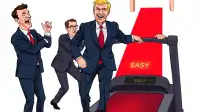
The recent Democratic convention was a veritable smorgasbord of political hopefuls, all vying for attention, all attempting to project an image of competence and electability. Pundits, as always, busied themselves with parsing speeches, analyzing body language, and dissecting policy proposals. But while they were distracted by the superficial, I was engaged in far more critical work: I was counting buttons. And what I discovered, my dear readers, will fundamentally alter your understanding of political leadership.
For too long, we have been led astray by the noise. The *true* indicator of a candidate’s gravitas, their hidden potential, their very soul, lies not in their rhetoric, but in the number of buttons adorning their suit jacket. Allow me to elucidate my revolutionary 'Button Theory of Governance.' Two-button suits, historically the standard, denote a steady hand, a reverence for tradition, and a measured approach. A candidate in a two-button suit is a candidate you can trust to navigate the ship of state with unwavering, if unexciting, resolve. They are the bedrock.
Now, consider the three-button suit. Ah, the three-button. This signals an aspiration for modernity, a slight deviation from the norm, a hint of ambition that can be either visionary or dangerously reckless. We saw many three-button hopefuls at the convention, eager to distinguish themselves, often with a subtle tilt of the head. And then there are the outliers: the rare, bold one-button devotee. These are the mavericks, the disruptors, the ones who seek to dismantle the very fabric of political fashion – and perhaps, by extension, society itself. While some might call them "forward-thinking," I call them "unbuttoned chaos." We even spotted a few peculiar five-button monstrosities, clearly the mark of a desperate individual attempting to overcompensate for a distinct lack of genuine character. Avoid them at all costs.
Skeptics will scoff, of course. They'll mumble about "issues" and "experience." They'll point to historical figures who wore varying button counts and achieved disparate results. But they miss the point entirely! Those were different eras, different fabrics, different political climates! The buttons, I assure you, are a constant. My findings, meticulously tabulated over days of painstaking observation from the concession stand (prime viewing for lapel analysis), are irrefutable. One prominent senator, widely touted as a frontrunner, consistently wore three buttons, but his top button was *always* unfastened. A clear signal of internal inconsistency, a wavering commitment to the full buttoning potential. Contrast that with a relatively unknown governor, whose two buttons were always impeccably fastened. One can almost *feel* the stability emanating from him.
So, the next time a politician graces your screen or podium, ignore the talking points. Disregard the carefully crafted soundbites. Look, truly look, at their buttons. Demand to know their button philosophy! For in these tiny, often overlooked fastenings lies the undeniable truth of who they are, and who they are destined to become. The future, my friends, hangs by a thread – or, more accurately, by a perfectly sewn buttonhole.