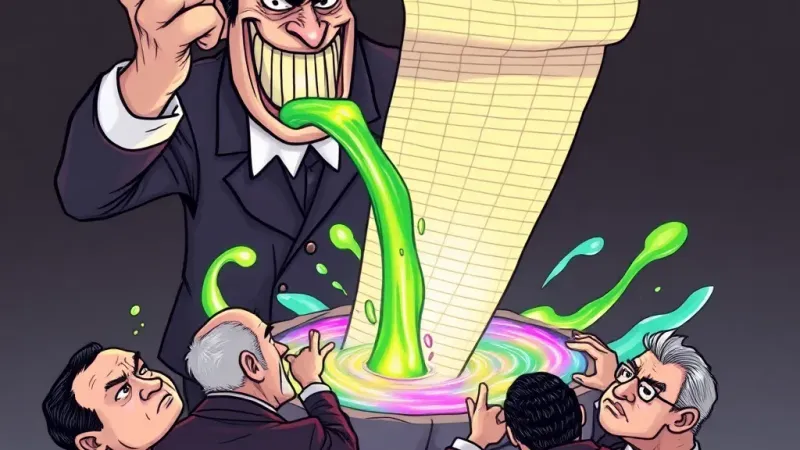
There’s a silent, insidious war being waged in the mahogany-paneled boardrooms of America, a clandestine battle far more critical than any market fluctuation or hostile takeover. The corporate punditry, with their endless charts and data points, will tell you it's about "succession planning" or "mounting pressures." They are, as usual, missing the entire glorious point. The true threat to corporate genius, my friends, is none other than the Chief Financial Officer.
Yes, I said it. Your CFO, with their stern pronouncements and impenetrable spreadsheets, is not merely a gatekeeper of funds; they are the silent saboteurs of innovation, the wet blanket doused over the fiery spirit of the visionary CEO.
Think about it. A CEO, a true leader, operates on instinct. They possess a sixth sense for opportunity, an unshakeable belief in the next big thing, a pure, unadulterated vision unburdened by the pesky realities of "cost-benefit analysis" or "return on investment." They are the artist with a blank canvas, ready to paint the future. And who walks in with a clipboard, tallying the price of every tube of paint, questioning the very shade of crimson you’ve chosen? The CFO.
Their relentless focus on "the numbers," on "prudence," on "fiscal responsibility" isn't a strength; it's a crippling weakness. It reduces ambition to an algorithm, vision to a forecast. When Steve Jobs was dreaming up the iPhone, do you honestly believe he was bogged down by unit economics and quarterly projections? No! He was *envisioning* a revolution. When Elon Musk dares to gaze at Mars, do you think he’s asking his CFO if the propulsion system fits into next year’s budget? Preposterous! He’s dreaming of rockets!
Some will inevitably cluck about "financial accountability" and "shareholder value." To them, I say: value is created not by counting beans, but by planting redwood forests! Accountability is for bureaucrats, not innovators. If you're constantly worried about the "bottom line," you'll never reach the "top tier" of greatness. True disruption demands a certain magnificent disregard for the mundane realities of the ledger. Success isn't measured; it's *felt*.
The spreadsheets, the pivot tables, the incessant "data-driven insights" — these are not tools of progress; they are instruments of fear. They shrink the scope of what’s possible, stifling the bold strokes of genius with a thousand tiny cuts of caution tape. What good is a brilliant idea if it's perpetually trapped in a "feasibility study"? What use is a groundbreaking product if it's never launched because the "ROI projection" didn't meet some arbitrary threshold?
CEOs, it’s time to reclaim your rightful throne. Cast off the shackles of financial conservatism. Trust your gut. Let your vision soar, unencumbered by the dreary pronouncements of the accounting department. Encourage your CFOs to dream bigger, not just count smaller. Or, better yet, reassign them to "corporate morale optimization" where their meticulous nature might be better suited to organizing the annual holiday party. The future of corporate America — indeed, the future of *vision itself* — depends on it.