
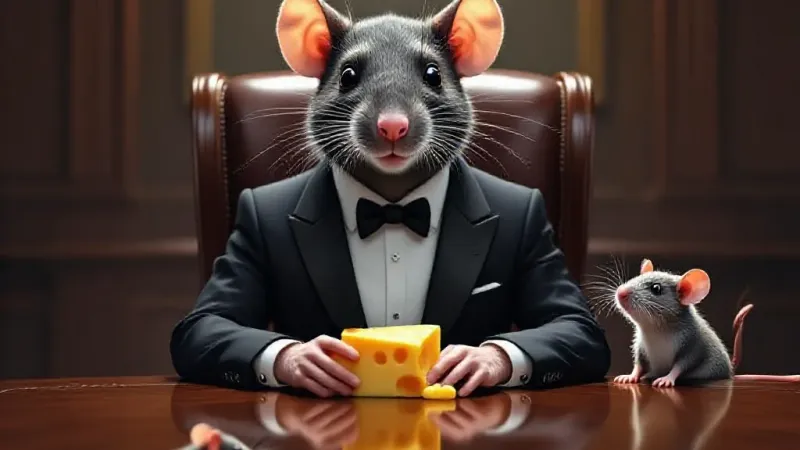
American researchers have discovered that laboratory rats, previously thought to be mere models for human behavior, exhibit an astonishing degree of empathy that would fundamentally disqualify them from any significant leadership position in the global capitalist economy. A 2011 study, revisited by leading experts in corporate pathology, observed rats consistently freeing cagemates before sharing food, a behavior now officially labeled 'an unacceptable liability' for any aspiring CEO or private equity partner.
Dr. C. G. Spikes, lead analyst at the Institute for Aspirational Proximity Studies, stated, 'These rats are making decisions based on collective well-being, not individual profit maximization. We saw instances of them actively *choosing* to liberate a trapped peer and then *sharing* their high-value chocolate pellets. This is not just inefficient; it's a fundamental misunderstanding of shareholder value. You simply can’t run a multinational conglomerate with that kind of moral compass. It's economically suicidal.'
The study’s findings highlight a critical dilemma for any organization considering rodent talent for executive roles. While rats demonstrate exceptional problem-solving skills and a strong drive for resource acquisition, their persistent urge to 'do the right thing' by their peers consistently overrides their capacity for ruthless market dominance. One rat, dubbed 'Chairman Squeakers' by researchers for its apparent leadership in freeing others, was observed dividing a single Dorito evenly among three other recently liberated cagemates, an action that would trigger immediate investigations by an ethics committee—or worse, a shareholder lawsuit—in any human corporation.
Further behavioral analysis indicated a lack of 'strategic indifference' to suffering and a complete absence of 'scalable exploitation techniques,' both considered baseline proficiencies for human leaders overseeing large workforces or supply chains. Their instinctive drive to assist peers suggests they would prioritize employee welfare and environmental impact over the quarterly projections, effectively sabotaging any chance of maximizing extraction and minimizing externalized costs.
The implications are stark: until a genetically modified 'apex predator' rat can be bred—one capable of hoarding resources, ignoring the plight of the less fortunate, and viewing community as merely a network for personal gain—rodents will remain relegated to their current roles as lab subjects and, at best, mid-level managers in departments focused purely on 'synergy' and 'employee engagement,' where genuine empathy can be superficially weaponized for corporate branding. It seems the glass ceiling for rats in the C-suite isn't about intelligence or drive, but an inconvenient, species-wide inability to be sufficiently awful.