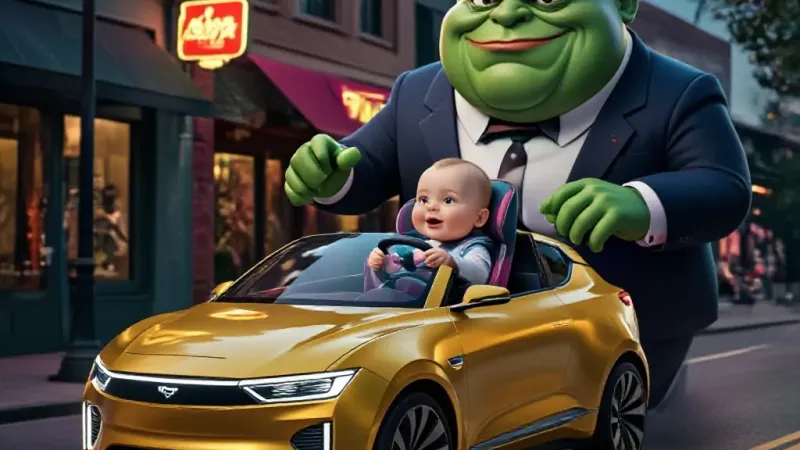
Tesla’s gold-tinted Cybercab, a two-seater central to Elon Musk’s "robo-supremacist ambitions," is slated for public launch in Austin, Texas, as soon as this month. The vehicle, designed without a steering wheel or pedals, faces significant doubts regarding its readiness for public roads and customers.
While employees have tested fully driverless versions on private roads around the company's campus since July, other Cybercabs observed around the country still included traditional controls for data gathering. Brad Cesak, a spokesperson for the city of Austin, confirmed that first responders recently completed training on how to move the vehicles in an emergency. The Cybercab relies on Tesla's "Full Self-Driving (Supervised)" software, which the company claims is "significantly safer than human driving." However, independent safety experts and federal regulators have questioned this assertion, noting the software requires "constant driver oversight" and is currently under investigation by the National Highway Traffic Safety Administration for traffic compliance failures.
Unlike Tesla’s existing Robotaxi service, which still uses human safety monitors in some markets, the Cybercab is designed for operation without human intervention, removing a critical safety layer. Tesla states remote operators can take control during emergencies, but experts worry about signal strength and latency hindering reactions. The company recently added Starlink to Cybercabs to address connectivity concerns. Adding to the challenge, Musk previously stated that Tesla needs to "accumulate driving data that is specific to the Cybercab." This suggests Tesla, once seen as a leader in data collection, may actually be a laggard for this specific platform. Ashok Elluswamy, the company’s head of AI, reported Tesla's unsupervised robotaxis have driven 380,000 miles across six cities. In contrast, Waymo, a commercial robotaxi service since 2020, has driven over 220 million fully driverless miles—approximately 579 times more.
Tesla has not submitted its safety claims for independent analysis, instead relying on self-published statistics. The company is "actively working to block public scrutiny" of data it is required to provide federal regulators. Waymo, conversely, has published multiple studies in peer-reviewed journals, with the nonprofit Insurance Institute for Highway Safety concluding its crash rates were significantly lower than human drivers. The Cybercab’s design also faces federal safety rules requiring features like pedals and side mirrors for public sale. Tesla would need an exemption from regulators to sell thousands of these vehicles, though it is unknown if they are seeking one, unlike Amazon’s Zoox which recently received such permission.
Despite being the lightest, most efficient electric vehicle Tesla has produced, its imminent launch in Austin arrives with crucial unanswered questions, suggesting its "robo-supremacist ambitions" may be significantly outpaced by reality.