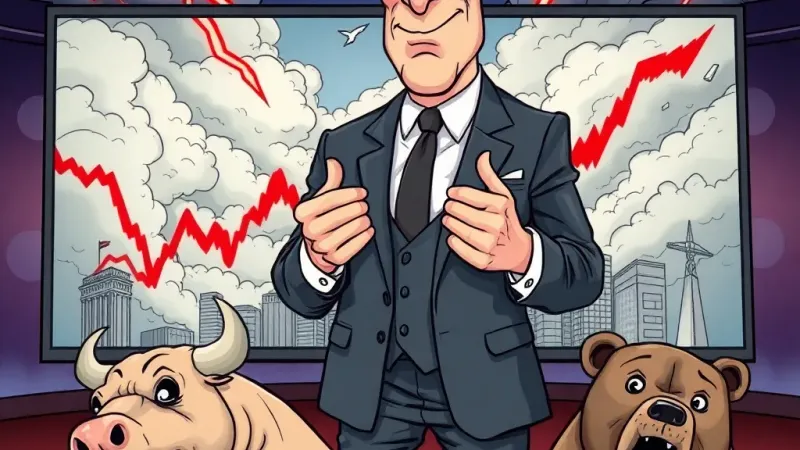
AUSTIN — Global markets experienced a sudden, inexplicable dip Tuesday morning after Dr. Sterling Cloudsdale, Chief Atmospheric Strategist for WeatherCorp Global Insights, issued a "Level 3 Atmospheric Micro-Downturn Advisory" for the Austin metropolitan area. The three-day forecast, characterized by "slightly elevated humidity and a 15% chance of light drizzle," prompted a rapid sell-off in key sectors, wiping billions from investor portfolios within minutes.
The advisory, delivered during the nightly 6 PM broadcast, detailed a mild cold front expected to reduce ambient temperatures by an average of 3 degrees Fahrenheit, alongside an increase in cloud cover that could potentially "impact outdoor leisure activities and disrupt optimal vitamin D absorption." Financial trading platforms, many configured to automatically respond to keyword alerts from influential data sources, immediately flagged Cloudsdale's pronouncement as a significant "atmospheric supply chain risk." The Dow Jones Industrial Average dropped 300 points, while the newly launched Global Umbrella Futures Index (GUFI) surged by 1,200 basis points before stabilizing.
"Frankly, it's just Tuesday," admitted Brenda 'The Bear' Caldwell, Senior Volatility Analyst at Goldman Sachs, visibly exasperated during a frantic CNBC segment. "But when Dr. Cloudsdale, with his 4.7-star Yelp rating for predictive accuracy, uses terms like 'moderate cumulus accumulation' and 'transient barometric instability,' the algorithms don't ask questions. They just dump shares of anything remotely connected to 'joy' or 'sunshine.' It’s pure, unadulterated predictive text panic." Caldwell pointed out that indices tied to 'outdoor dining satisfaction' and 'spontaneous park visits' saw the sharpest declines.
Dr. Cloudsdale, reached for comment while meticulously arranging isobar maps, expressed mild bewilderment at the market's reaction. "My job is to provide data, not financial advice," he stated, adjusting his perfectly knotted tie. "If investors can't handle a 20% chance of 'partially cloudy with an afternoon breeze,' perhaps they should reconsider their asset allocation strategy, or at least invest in a good windbreaker. This isn't a Black Swan event; it’s just, you know, weather."
He then clarified that the 'downturn' was expected to reverse by Friday afternoon, potentially offering a "brief window of optimized outdoor recreational opportunity." Analysts are now debating whether to re-categorize weather forecasts from "natural phenomenon" to "unregulated speculative asset," effectively allowing central banks to intervene in case of severe thunderstorms.