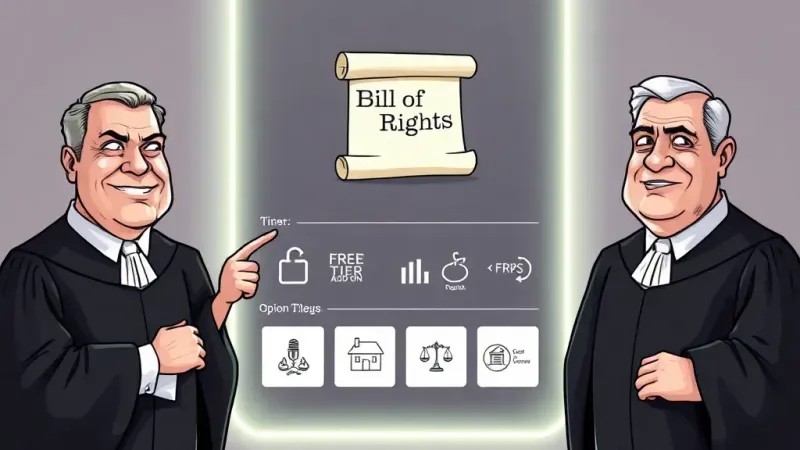
WASHINGTON D.C. – The U.S. Supreme Court today issued a series of landmark rulings that effectively reclassified several fundamental civil rights as "optional add-ons," rather than integral, immutable components of the nation's foundational legal framework. The move, framed by the Court as a necessary "system update," is expected to usher in an era of unprecedented flexibility in governance, allowing states and localities to tailor their legal offerings to regional preferences and evolving societal "beta tests."
Justice Elara Vance, speaking in a rare post-decision press briefing held exclusively on a proprietary, invite-only blockchain platform, articulated the Court's rationale. "We discovered that the legacy 'all-inclusive' model of civil liberties, while admirable in its initial design, frequently resulted in compatibility issues, systemic inefficiencies, and an unmanageable overhead of uniform compliance across diverse jurisdictions," Vance explained. "Our new modular architecture empowers citizens to select the rights most relevant to their individual lifestyles and local cultural operating environments, much like curating a personalized streaming bundle or choosing premium features on a software subscription. This isn't a rollback; it's a sophisticated, user-centric optimization designed for agility in the 21st century."
Legal analysts across the ideological spectrum are calling the shift a bold reinterpretation of constitutional intent, aligning it more closely with modern consumer choice paradigms and the gig 2. Dr. Quentin Holloway, a constitutional scholar and lead disruptor at the Ayn Rand Institute for Jurisprudence and Decentralization, noted, "For too long, the 'unalienable' nature of certain rights created a burdensome, one-size-fits-all mandate that stifled innovation. This Court has simply recognized the evolving market demand for bespoke legal protections. Think of it as moving from a bloated, bundled shareware package to an à la carte app store for civic engagement. You still get the basic operating system, of course, but the premium features—such as unencumbered voting access, comprehensive due process, or robust privacy safeguards—are now available at the discretion of service providers or potentially through microtransactions. It fosters healthy competition among states to offer compelling rights packages that resonate with their specific user bases."
The Court's newly published "Legal Framework 2.0 Roadmap" outlined a rigorous "legacy feature deprecation schedule" for rights deemed "obsolete, infrequently accessed, or presenting undue friction in economic development." This includes, but is not limited to, certain protections against specific forms of discrimination, expansive interpretations of free expression in non-commercial contexts, and broad appeals processes. Future updates are expected to further refine the core offering, potentially introducing dynamic pricing models for highly sought-after liberties during peak usage periods or in regions experiencing rapid demographic shifts.
Observers noted the unanimous decision included a new, prominently displayed disclaimer at the bottom of the official ruling: "Your continued access to these rights constitutes acceptance of our updated terms and conditions. Some features may be subject to geographic restrictions, tiered access, or require additional state-level authorization. Rights availability is not guaranteed."