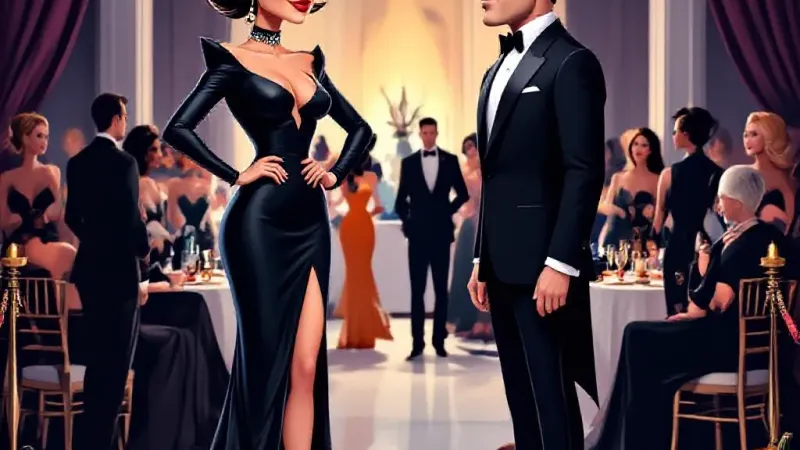
LOS ANGELES — A groundbreaking new study from the Institute for Aspirational Proximity Studies (IAPS) has confirmed what many have long suspected: celebrities primarily perceive other celebrities as fully formed, recognizable human beings. Non-famous individuals, according to the research, register primarily as “ambient noise” or “mobile background props.”
TheThe study, which meticulously tracked celebrity eye-tracking data, social media engagement patterns, and “organic” event attendance over five years, pinpointed a critical moment of validation: Halloween. “When a celebrity dresses up as another celebrity, it’s not just a costume; it’s an act of profound recognition,” explained Dr. Cassandra Vance, lead researcher at IAPS. “It’s their most intense form of acknowledging another's existence outside of a mutually beneficial brand deal or a shared agent. For 24 hours, they truly *see* each other.”
Researchers noted a marked uptick in neurological activity when subjects encountered images or mentions of fellow A-listers. Conversely, encounters with “regular people” — defined as anyone without at least two major awards or a net worth exceeding nine figures — resulted in brainwave patterns consistent with processing inanimate objects or, at best, low-priority spam emails. “It's not malicious,” Dr. Vance clarified. “It's an evolved efficiency. Their brains filter out anything not directly related to their brand, their projects, or their public image. Think of it as a highly sophisticated, self-optimizing algorithm for social interaction.”
One celebrity publicist, speaking anonymously on condition of anonymity, confirmed the findings were “standard operating procedure.” “Why would [my client] waste cognitive bandwidth on someone who can't open doors, secure a cover spread, or be part of a 'fun' TikTok collab?” the publicist asked. “The Halloween costume is actually a networking event. It shows respect within the ecosystem. 'Look, I know who you are, I appreciate your cultural footprint, and I'm available for a voiceover role if yours falls through.'”
The study also found that prolonged exposure to non-celebrities can induce a state of mild confusion, often misinterpreted by onlookers as “humility” or “down-to-earth charm.” “They're not being humble,” Dr. Vance stated. “They're genuinely trying to process why a human-shaped entity is speaking to them without a script or a pre-negotiated fee. It’s like trying to make sense of a foreign language when you only speak 'Hollywood Billionaire' and 'Agent's Daughter.'”
The implications are far-reaching. The IAPS recommends that major awards ceremonies begin including a segment where celebrities are briefly shown images of non-famous individuals to prevent complete cognitive atrophy. “Just a quick flash of a plumber or an accountant,” Dr. Vance mused. “Just enough to remind them other forms of life exist. Maybe. We're still running trials.”
The research further suggested that without this annual ritual, the entire celebrity class might simply fade into a self-consuming singularity of unacknowledged egos.