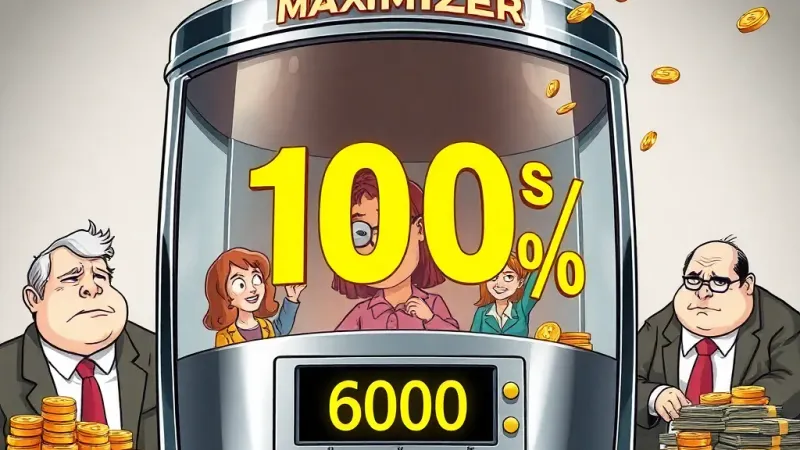
LOS ANGELES — Global media conglomerate ZenithCorp confirmed Tuesday that the “Abbott Elementary” cast has undergone a mandatory 600% revaluation of their baseline worth, effective immediately upon the production of the beloved sitcom's 100th episode. This unprecedented spike, according to internal documents, reflects the activation of a previously inert “Critical-to-Monetization Threshold” clause in their initial contracts.
“The 100-episode mark is not merely a symbolic achievement; it is a meticulously calculated inflection point within our proprietary ‘Intellectual Property Lifecycle Metrics’ framework,” stated Dr. Alistair Finch, ZenithCorp’s Senior Vice President of Content Asset Optimization, in a company-wide memo. “Prior to episode 100, talent is classified under ‘Emerging Market Risk Allocation.’ Post-100, they transition to ‘Established Brand Equity Holders.’ This distinction, while seemingly granular, represents a substantial shift in permissible payroll allocation.”
Dr. Finch elaborated that the show’s critical acclaim and multiple Emmy Awards were, “analytically speaking, valuable data points for market validation, but not, strictly speaking, *revenue drivers* until the 100-episode hurdle was cleared.” He explained that the initial contracts are designed to minimize upfront exposure until a project demonstrates sufficient “perpetual syndication viability” and “secondary market licensing robustness,” a strategy perfected during the tumultuous streaming wars where early content overspending crippled several smaller studios. The creative process itself, Dr. Finch assured, remains “a vibrant conduit for the generation of future monetizable assets.”
While audiences celebrate “Abbott Elementary” for its sharp writing, heartfelt performances, and unique take on public education, ZenithCorp’s metrics reportedly filtered these subjective elements through a proprietary algorithm dubbed “Audience Sentiment-to-Enterprise Value Conversion Matrix 7.3.” This matrix confirmed that while critical darlings often struggle with long-term financial viability, the 100-episode milestone for *this specific type* of content provides an optimal “de-risking profile” for future monetization efforts across various global distribution channels. The actual jokes, plotlines, or emotional impact, sources confirm, were less relevant than the “episode count multiplier” reaching its optimal integer.
Industry analysts agree the 100-episode trigger is less about artistic merit and more about a universal milestone for content libraries. “It’s when a show truly becomes an evergreen product, ripe for licensing to streaming platforms in perpetuity, or for spinning off into international adaptations and merchandise lines,” explained Dana Sterling, a talent economist at the 2 Institute for Predictive Analytics. “Until then, it’s just ‘a show.’ Afterward, it’s ‘an asset,’” Sterling added that this revaluation process is standard across the industry, ensuring that “talent is adequately incentivized to produce precisely 100 episodes — the point at which an IP’s depreciated cost basis aligns optimally with its projected residual revenue streams — but not a single episode more than contractually necessary before the financial floodgates are reassessed for a new, higher tier of profitability.”
The cast members, now deemed 600% more valuable, are reportedly considering using their newfound leverage to request amenities such as “adequate craft services” and “chairs that don't immediately collapse.”