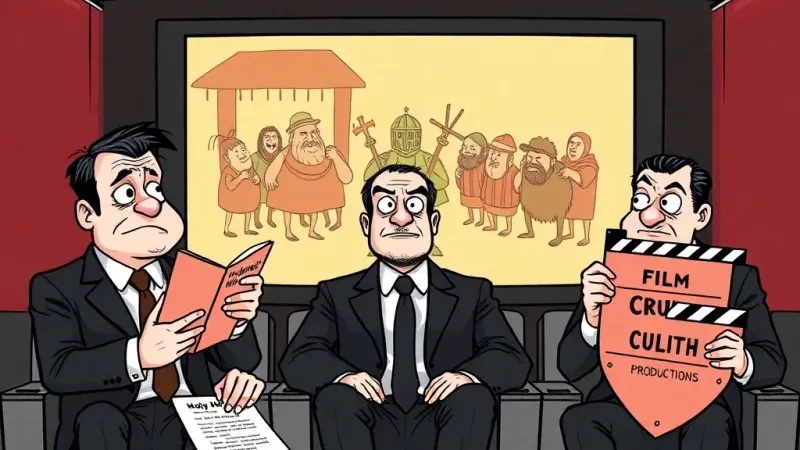
A major faith-based film studio, Trinity Pictures, expressed profound bewilderment today after their latest comedic offering, "The Good Word," received unexpected criticism for its plotline centered on the humorous, often slapstick, conversion of non-Christian characters. Industry analysts noted the film's ambitious marketing had promised a "lighthearted exploration of faith's journey," apparently overlooking the inherent humorlessness of unsolicited religious conversion from the perspective of the unconverted, particularly when that journey is depicted as a series of well-intentioned but deeply invasive pranks.
"Honestly, we thought we had an absolute winner on our hands," stated Bethany Trueheart, Head of Inspirational Content at Trinity Pictures, in an internal memo leaked exclusively to The Hambry. "The script tested incredibly well with our core demographic, who consistently rated scenes depicting characters abandoning their ancestral faiths for a 'new beginning' as 'charming' and 'truly uplifting.' We genuinely never anticipated that the 'journey' part would be interpreted by anyone else as, well, target practice for their deeply held personal beliefs." The film, which features a quirky ensemble cast attempting to "win over" their Jewish neighbors with increasingly elaborate pranks, musical numbers, and strategically placed evangelical literature, reportedly earned a perfect "family-friendly" rating from the Alliance for Moral Cinema, an independent ratings board dedicated to promoting values-aligned entertainment.
Sources close to the production indicated that early focus groups, conducted primarily within heavily tithing megachurch communities across the Sun Belt, praised the film's "relatable struggle" and "comedic earnestness." The specific inclusion of Jewish characters was, according to an uncredited junior producer involved in the project, a "strategic demographic choice" intended to "broaden appeal beyond just converting the atheists and yoga instructors." This move, they explained, aimed to tap into a wider, yet still conversion-ready, audience segment. Trinity Pictures had reportedly budgeted an additional $1.7 million for a post-release "empathy consultant" to address potential "misunderstandings" with audiences not explicitly seeking a cinematic nudge towards spiritual transformation, viewing any backlash primarily as a public relations hurdle rather than a fundamental flaw in premise.
Entertainment news outlets, typically quick to celebrate "diverse storytelling" and "bold new voices," struggled to frame the ensuing controversy. Variety, for instance, initially ran a headline asking, "Is Conversion Comedy the Next Frontier in Inclusive Cinema?" before sheepishly updating it to "Conversion Comedy: A Bridge Too Far for Interfaith Dialogue, Or Just a Misunderstood Masterpiece?" Meanwhile, Rabbi Mendel Goldberg, Director of the Interfaith Harmony Project, offered a blunt assessment during a recent podcast appearance. "It's truly a groundbreaking cinematic achievement if your primary goal was to make everyone feel profoundly uncomfortable, regardless of their spiritual background," Goldberg remarked. "It's like a 'fixer-upper' reality show where the 'fixer' just bulldozes your house and installs a petting zoo without asking, then expects you to thank them for the unexpected livestock."
Trinity Pictures confirmed that while "The Good Word" would continue its theatrical run, they might explore a sequel where the characters attempt to "humorously" convert their neighbors to a specific brand of artisanal, gluten-free, organic Kombucha.