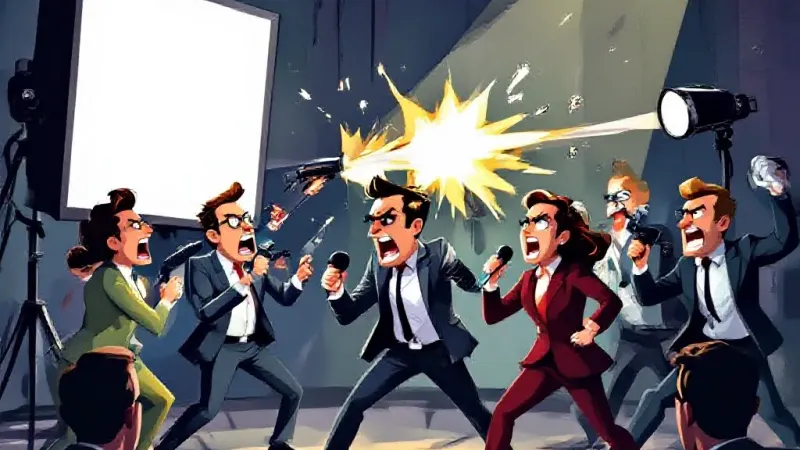
NEW YORK – Major sports leagues and media conglomerates have officially declared a full-scale "Summer Attention War," commencing this week, vying for the fleeting gaze of American consumers. The heavily publicized conflict, initially framed as a battle between professional basketball and soccer, has reportedly expanded to include competitive hot dog eating, TikTok trends involving aggressive pet grooming, and the compelling allure of a flickering ceiling fan. Analysts confirm the public's primary summer activity remains aggressively ignoring all scheduled programming in favor of literally anything else.
"This is not just about viewership; it's about mindshare, eyeballs, and the sheer computational power required to ignore the increasingly desperate pleas of multinational corporations," stated Dr. Kendra Thorne, Chief Engagement Strategist for the newly formed Institute for Monopolized Eyeballs. "Our proprietary data shows a critical attention deficit in the 18-49 demographic, particularly when faced with bright sunshine, the existential dread of a cluttered garage, or the sudden realization that their smart thermostat is actively working against them. The stakes are unprecedentedly low, yet the marketing budgets are catastrophically high, creating a feedback loop of escalating irrelevance." Thorne presented a "Neural Drift" model, demonstrating that peak American summer engagement occurs primarily when someone yells "Look!" at a particularly interesting bird or remembers they left the stove on.
The NBA, fresh off its finals, is reportedly deploying "hyper-localized content bombs," including micro-documentaries about backup point guards’ favorite regional ice cream flavors and augmented reality filters that superimpose a tiny basketball hoop onto your neighbor's dog. Meanwhile, soccer organizations are counter-programming with "authentic fan experience initiatives" that mostly involve showing empty stadium seats in European leagues to an increasingly indifferent domestic audience, punctuated by 30-second spots of former players awkwardly attempting to explain offside rules to confused schoolchildren. Networks are investing heavily in new graphics packages designed to make a mid-game water break feel as significant as a national debt ceiling debate.
"We project that by mid-August, the average American will have spent approximately 2.7 minutes contemplating either type of sports ball, collectively," commented veteran sports analyst Skip Bayless, inexplicably still employed. "The rest of their waking hours will be dedicated to figuring out why their Wi-Fi is slow, scrolling past ads for things they don't need, arguing with a customer service bot, or silently judging neighbors' aggressively unkempt lawn care choices. This strategic apathy, this sublime indifference, has created a vibrant secondary market for distraction that media companies are now desperately trying to co-opt by funding viral videos of cats playing chess."
Ultimately, industry insiders confirm the "war" is less about athletic supremacy and more about maximizing the fractional percentage of human consciousness not already consumed by minor anxieties, the captivating rhythm of a ceiling fan, or the relentless pursuit of the perfect iced coffee. As one network executive, speaking anonymously from his Hamptons yacht, admitted, "We just need them to glance long enough to see the car commercial, the insurance jingle, or the pharmaceutical ad. That's the real win. If they actually *watch* the game, that’s just gravy, and frankly, a bit unsettling."