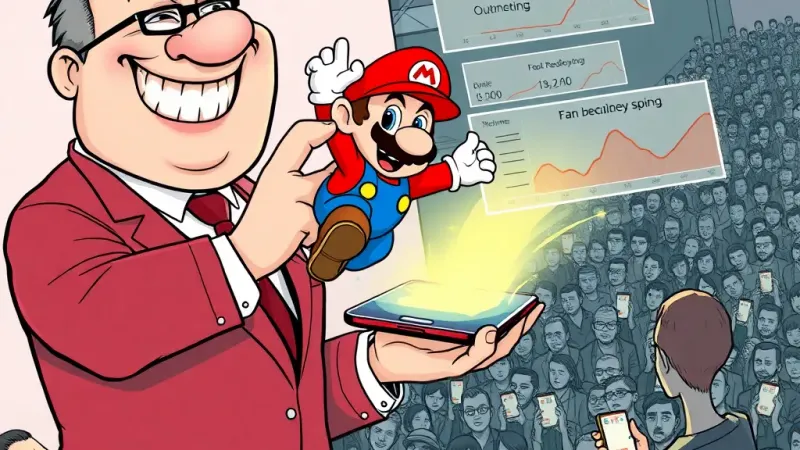
LOS ANGELES — Paramount Pictures announced Tuesday that The Super Mario Galaxy Movie has arrived on streaming platforms significantly ahead of its originally scheduled release. Studio executives clarified the move was less a generous offering and more a desperate attempt to keep pace with the modern consumer's evaporating attention span. The animated feature, which enjoyed a theatrical run of just under three weeks, was pulled from cinemas after internal analytics projected a mass cultural fatigue event if audiences were forced to wait any longer than the absolute minimum for its home debut.
"We understand that a 21-day theatrical exclusivity period can feel like an eternity to our valued subscribers, particularly those under 35 who primarily consume content in hyper-condensed, algorithm-optimized bursts," explained Dr. Evelyn Reed, head of Predictive Content Flow at Paramount Global. "Our proprietary Fan Urgency Index (FUI) hit a critical 8.7 last Thursday — a level indicating a significant portion of our target demographic had already mentally moved on. To delay further would have been irresponsible, frankly, risking a catastrophic drop in engagement metrics and the potential for collective cultural memory loss regarding the film's very existence." Reed confirmed that future tentpole releases would aim for a "simultaneous conception-to-streaming model" to better serve the market's insatiable demand.
The decision follows a worrying trend for traditional cinema, where "early streaming access" has quickly become the expected default. Industry analysts point to dwindling interest in leaving the house, coupled with advanced AI-driven home entertainment systems that can now perfectly replicate the sticky floors, overpriced snacks, and disruptive audience members of a multiplex. "The entire concept of 'waiting' for a movie feels archaic, almost quaint, like reading a physical newspaper or making eye contact with strangers," noted Chad Bronson, a 24-year-old content consumer who claims to have watched the entire Super Mario Galaxy Movie while simultaneously scrolling four different social media feeds and livestreaming his reaction to a fifth. "Why would I actively plan an outing when the content can just, you know, *be* in my living room? It's like asking me to walk to a well for water when I have a faucet that dispenses pre-digested narrative directly into my brain."
Bronson, who also moonlights for the "Pre-Hype De-Escalation Metrics" team at a major tech firm, believes studios are still behind the curve. "Honestly, if it's not available for pre-load directly into my neural interface, it's already too late. I've already imagined the entire plot in sufficient detail through algorithm-fed fan theories and AI-upscaled leaked production art." He speculated that within five years, major blockbusters would forego any external release entirely, opting instead for "direct-to-subconscious content drops" during mandatory sleep cycles, optimized for minimal REM interference.
In response to these evolving consumption patterns, Paramount has reportedly fast-tracked development on an "Instantaneous Narrative Deployment" (IND) system. This aims to transmit entire movie plots, emotional arcs, and character development directly into consumer dreams, thus eliminating the cumbersome need for visuals, dialogue, or even active viewership. A studio spokesman, speaking on condition of anonymity while juggling three active subscriptions on his work phone, confirmed the IND system's primary goal was to "reduce friction" in the content pipeline and "ensure every narrative beat arrives exactly when the user has forgotten they even wanted it."
The studio is confident this will finally solve the problem of audience members remembering they have other things to do.