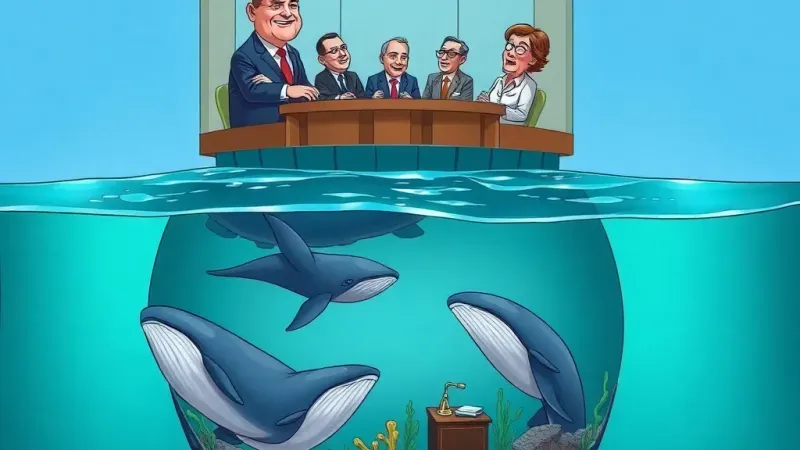
(Wellington, NZ) – A recent sperm whale birth observed off the coast of New Zealand has provided scientists with "unsettlingly clear" insights into animal cooperation, prompting several international bodies to question why analogous levels of social cohesion remain largely aspirational for human societies. The cetacean pod reportedly engaged in a synchronized, multi-stage support system, demonstrating a proactive defense perimeter and shared nutritional foraging, all without a single committee meeting or partisan deadlock.
"It's frankly humiliating," stated Dr. Aris Thorne, lead marine biologist at the Pelagic Governance Institute, who observed the event. "Here we have a highly complex, deep-diving mammal species executing what amounts to a full-scale birthing and post-natal care operation with an intuitive, seamless efficiency. There were no arguments over resource allocation, no competing factions vying for control of the 'gestational support pod,' and certainly no legislative filibuster on whether the calf truly needed that much oxygen." Thorne noted that the whales' "Cetacean Social Consensus Matrix" appeared to be operating at near-perfect optimization, a stark contrast to any human city council meeting he’d ever witnessed.
The findings have reportedly caused considerable consternation among global leadership, with several unnamed parliamentary aides requesting briefings on "whale-based policy frameworks." One internal memo, leaked from a major G7 nation's department of public works, questioned if "the whales somehow possess an innate understanding of infrastructure maintenance that we consistently fail to grasp, given their obvious lack of potholes." Experts are now reportedly exploring whether attaching tiny GoPro cameras to select heads of state during their morning routines might yield similar insights into basic task execution.
"We’re trying to understand how they achieve such robust community support without a single tax increase, or even a 'wellness' initiative that nobody actually participates in," admitted Marcus Finch, a senior policy analyst at the Global Bureau of Human Socio-Political Studies. "Their 'proactive defense protocols' during the birth involved every adult whale present, each instinctively knowing its role and executing it without prompting, departmental turf wars, or the need for a motivational seminar. Frankly, we've had more difficulty coordinating a potluck dinner among our own staff for the annual holiday party, let alone a multi-species global warming mitigation strategy. The implications for parliamentary decorum and urban planning are, quite frankly, depressing."
Scientists are now cautiously optimistic that, with enough observation, humans might eventually achieve the organizational proficiency of a marine mammal that communicates primarily through clicks and whistles.