
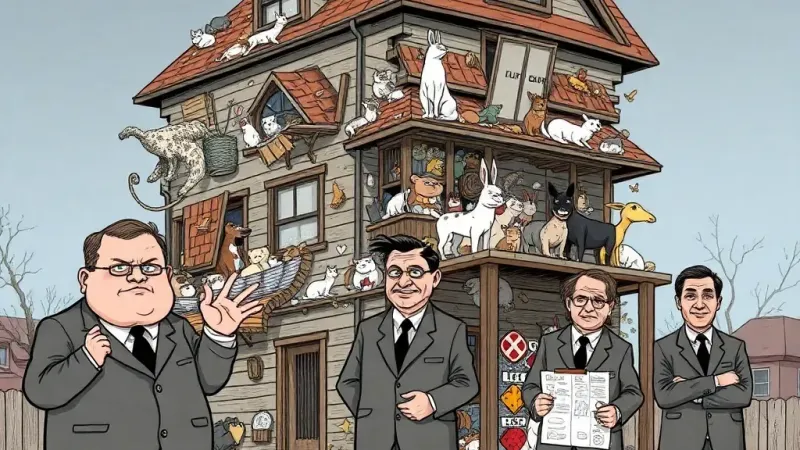
Scranton, PA – Municipal officials in Scranton have announced the reclassification of a residential property containing what they describe as a "dynamic, multi-species assemblage" of over 300 live and deceased animals. The home, previously subject to a health hazard investigation, will now operate under the newly introduced "Distributed Urban Bio-Habitat" (DUB-H) designation, streamlining future oversight efforts and potentially setting a precedent for similar properties.
"The previous 'health hazard' terminology was frankly unhelpful and often led to negative public perception, complicating inter-departmental resource allocation," explained Councilwoman Mildred Finch, chair of the newly formed "Inter-Species Co-Habitation Task Force," established just last Tuesday. "By embracing the DUB-H framework, we pivot from punitive measures to a more holistic, systems-based approach. We're not saying it's *good* in the traditional sense, but it *is* an existing condition, and our goal is to manage existing conditions efficiently, without the emotional baggage." She clarified that the new designation significantly reduces paperwork for animal welfare services, health inspectors, and waste management.
Initial assessments, conducted via drone flyover and a brief, masked "perimeter observation," indicate a "self-regulating nutrient cycle" within the premises, with a projected 0.04% daily increase in biomass efficiency, according to Dr. Arlo Thorne, a freelance ecological consultant brought in by the city at a rate of $850/hour. "The diversity of fauna, ranging from common domesticated pets to several highly adaptable commensal rodent colonies and a robust entomological stratum, presents a unique urban micro-ecosystem rarely observed in such contiguous domestic units," Dr. Thorne reported. "We're particularly excited about the endogenous waste decomposition protocols and the potential for a localized, self-sustaining detritivore population to handle organic refuse. It’s a remarkable example of natural systems adapting to anthropogenic pressures."
The city also announced that while the resident, who prefers to remain anonymous and continues to reside at the property, has been asked to complete a mandatory "Bio-Habitat Stewardship Certification" course offered online by a third-party vendor, no immediate eviction or animal removal is planned. Instead, the focus will be on "resource optimization" and "community engagement" through guided tours for environmental 2 students. Environmental advocacy groups are reportedly watching the Scranton pilot program closely, citing its potential to redefine urban planning for "resilience in an era of resource scarcity and shifting population densities." A representative from one such group, "Eco-Solutions Now," noted, "If we can manage 300 animals in a single home, imagine the possibilities for urban rewilding!"
The property's new classification also reportedly exempts it from standard municipal garbage collection, shifting all organic and inorganic waste management responsibilities to "nature's intricate recycling network, as facilitated by the resident."