
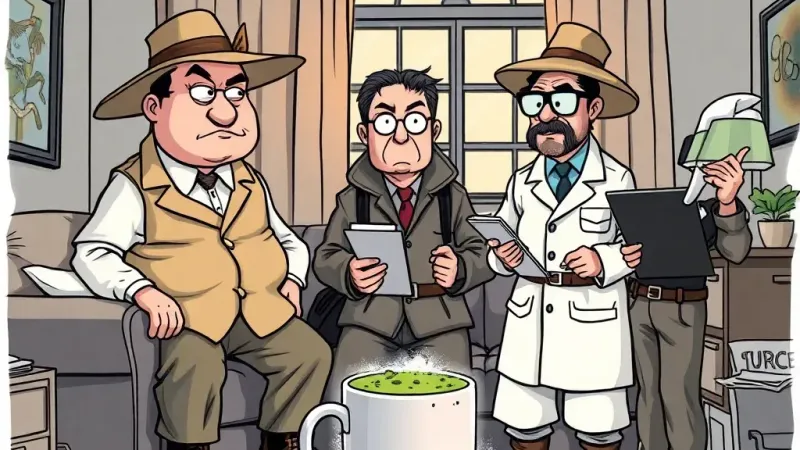
SCRANTON, PA – Following the recent discovery of what officials are terming a “highly diverse, spontaneously generated multi-species cohabitation zone” within a residential property, the City of Scranton has announced the immediate launch of the “Domestic Biome Project.” This groundbreaking initiative aims to comprehensively study the complex ecological dynamics of uncontrolled animal populations and organic material accumulation inside human dwellings, rather than simply addressing them.
The project, which will draw upon resources from the Department of Housing and Urban Development, the Environmental Protection Agency, and the National Institutes of Health, seeks to develop a deeper understanding of these unique indoor ecosystems. “Our initial findings indicate a fascinating interplay of predator-prey 2, symbiotic microbial growth, and an unexpected resilience in waste-to-energy conversion systems,” stated Dr. Evelyn Reed, lead bio-spatial anthropologist for the newly formed Inter-Agency Task Force on Residential Bio-Complexity. She added, “The sheer volume and variety of biological agents present—from several dozen feline specimens to various avian and rodent populations, along with robust insect communities and an impressive fungal network—suggest a self-sustaining environment previously unobserved in typical urban settings. It’s a truly unprecedented bio-urban interface.”
Funding for the Domestic Biome Project is projected at $17.3 million over its initial three-year phase, primarily allocated to long-term data collection, environmental monitoring, and the development of predictive models for similar “habitat emergences” across the Rust Belt. Specialized teams are currently utilizing advanced lidar scanning and atmospheric particulate analysis to map the internal structure and gaseous exchange patterns of the primary research site, designated "Scranton Biome-001." “We are looking at a full spectrum of organic decomposition, from rapid anaerobic processes to advanced entomological activity, providing invaluable insights into adaptive resilience under resource-constrained conditions,” explained Marcus Thorne, Deputy Director of Emergency Ecosystem Management for the city, noting that researchers are particularly keen on understanding the "bio-indicator species" found in the kitchen sink.
Critics, some of whom have colloquially referred to the project's subject as "just a really messed-up house with dead animals in it," have questioned the substantial investment. However, Mayor Patrick O’Malley defended the project’s scope, emphasizing the long-term scientific benefits. “To simply ‘clean up’ this environment would be to destroy a priceless living laboratory, potentially losing critical data on micro-climate adaptation and the human tolerance for escalating bio-load,” O’Malley said in a press conference yesterday. “We believe the insights gained here will be invaluable for future urban planning, particularly in predicting the ecological impacts of unfettered human disengagement from basic maintenance protocols.” The Scranton Planning Commission has already begun drafting preliminary proposals for new zoning regulations that would designate "bio-diverse residential zones" for future research and observation, bypassing traditional health and safety codes in favor of scientific exploration.
In the meantime, local residents have been advised to report any homes exhibiting "unusually robust internal ecosystems" to the Domestic Biome Project hotline, staffed by interns with advanced degrees in theoretical ecology who are ready to "document and analyze, but under no circumstances intervene."