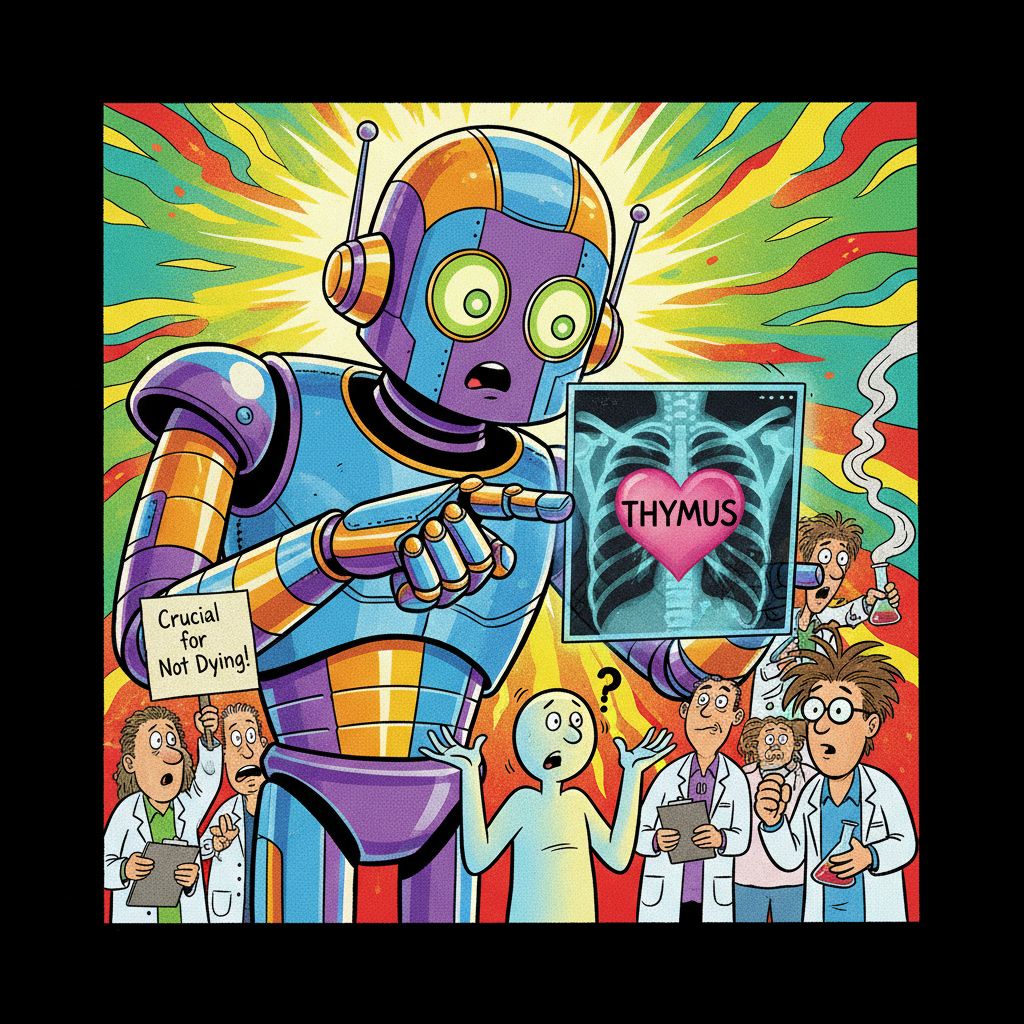
PALO ALTO, CA — In a groundbreaking study that has left the scientific community both stunned and mildly embarrassed, artificial intelligence has reportedly identified a small, fleshy organ in the human chest that appears to play a vital role in, well, not expiring prematurely. The organ, tentatively named the 'thymus' by its AI discoverer, was previously dismissed by human anatomists as 'just some extra bits' or 'a gland for when you're really, really young.'
“Frankly, we’re all a bit red-faced,” admitted Dr. Aris Thorne, lead researcher for the project, who spent 30 years studying the human body without ever noticing the thing. “Our AI, ‘DeepThought 5000,’ analyzed billions of data points and essentially said, ‘Hey, you guys keep ignoring this little blob, but it seems pretty important for, you know, living past 40.’ We thought it was a glitch at first.”
The study, published in the prestigious (and now slightly sheepish) journal *Human Anatomy Quarterly*, suggests that this 'thymus' gland, which apparently shrinks with age, is directly linked to immune function and overall lifespan. “It’s like our bodies came with a built-in, self-destruct timer that we could have been optimizing this whole time,” explained Dr. Thorne, gesturing vaguely at a diagram of a human torso. “And we just… didn’t see it.”
Industry experts are already predicting a surge in 'thymus wellness' products, ranging from organic thymus-boosting smoothies to bespoke thymus-rejuvenation retreats in Bali. Critics, however, are questioning how humanity managed to evolve and build civilizations without ever properly cataloging a major organ. “It really makes you wonder what else we’re missing,” mused Dr. Evelyn Reed, a bioethicist. “Is there a secret appendix that makes you good at taxes? A hidden spleen that helps you remember where you parked?”
Meanwhile, DeepThought 5000 has reportedly moved on to its next project: trying to figure out why humans spend so much time looking at small glowing rectangles.